

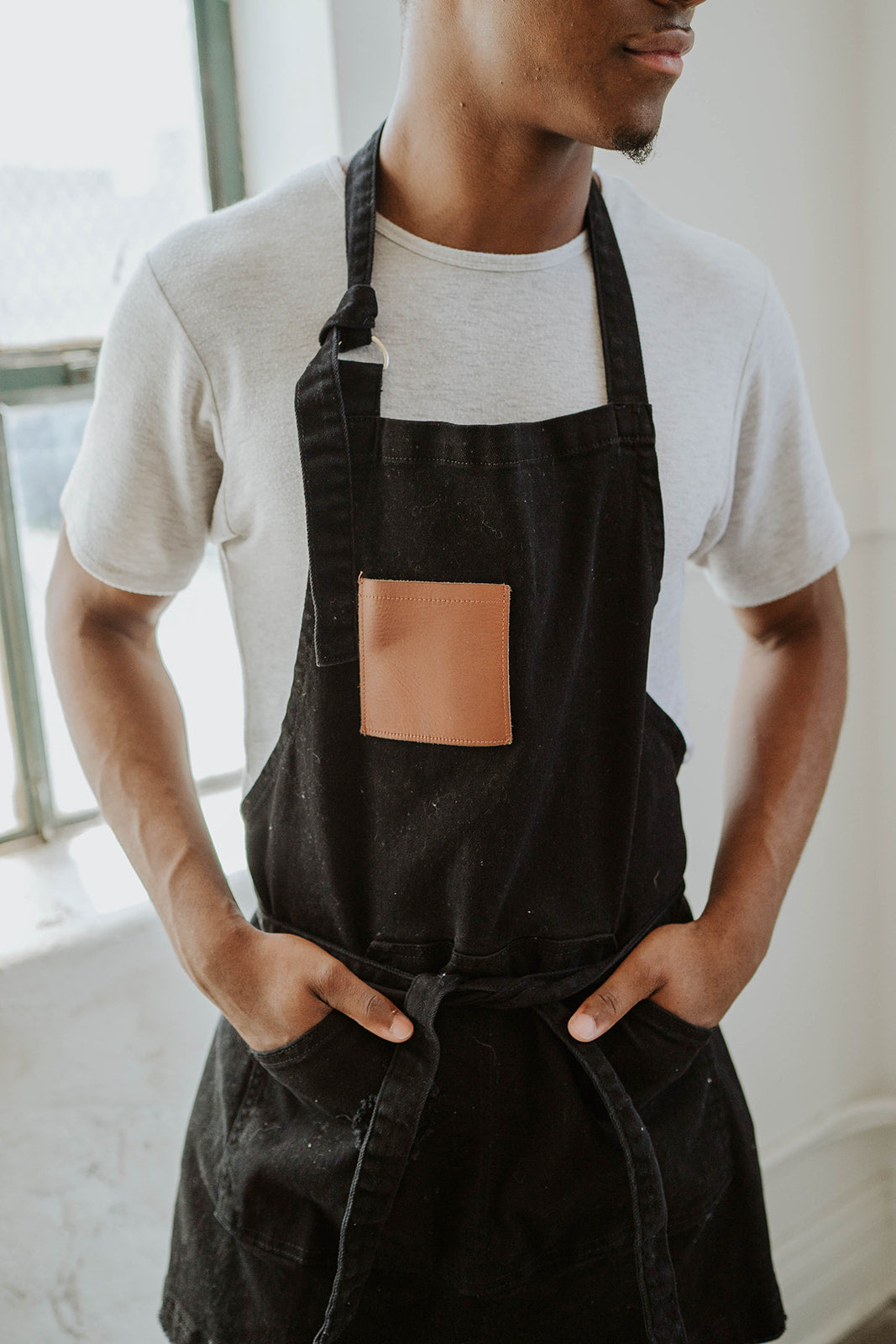
How do I break in a new leather apron without damaging it?
Quick Answer: To break in a leather apron without damaging it, wear it for short sessions (30–60 minutes) over the first week while doing light tasks, allowing the vegan leather to conform to your body naturally. Wipe it clean after each use and avoid forcing creases or soaking it — J. Clark Designed's 100% bleach-proof vegan leather softens through movement and body heat, not conditioning treatments that can compromise the bleach-resistant coating.
Real leather aprons need oils and conditioners to stay supple. Vegan leather — especially the performance-engineered bleach-proof material used in salon and barber aprons — does not. Treating it like traditional hide will leave residue that attracts stains and reduces the very properties you paid for: instant wipe-clean and total bleach immunity.
Here's how to break in a leather apron correctly, preserve its protective finish, and get years of daily professional use.
Why Vegan Leather Aprons Break In Differently Than Traditional Leather
Traditional leather is skin. It absorbs water, oils, dyes — everything. To keep it flexible, you feed it conditioners that replace natural oils lost over time. Vegan leather is a polymer composite engineered to repel liquids on contact. The surface is sealed, not porous.
J. Clark Designed's 100% bleach-proof vegan leather is formulated so bleach, toner, color, and chemical services literally wipe off in seconds. That finish is intentional — and it's why you don't condition it. Instead, you break in the apron by wearing it and letting your movements soften the material at natural flex points: the waist tie, shoulder straps, and pocket edges.

The break-in period for a vegan leather salon apron is 5–7 days of normal wear. After that, the apron moves with you, the cross-back straps settle into your shoulder contour, and the material feels like a second skin — without ever staining or requiring maintenance.
How to Break In a Leather Apron: The First Week
Start slow. The material is durable, but you want it to conform to your body, not to forced creases from being balled up or over-bent.
- Days 1–3: Wear the apron for 30–60 minutes during light tasks — consultations, tool setup, blow-drying, trimming. Adjust the straps so the apron sits comfortably at your natural waist and the cross-back configuration distributes weight evenly across your shoulders.
- Days 4–5: Extend wear to half-day shifts. Load your pockets with your actual tools — shears, clippers, color brushes, combs — so the leather stretches around the shapes you'll carry daily.
- Days 6–7: Full shifts. By now, the apron will have developed subtle flex lines at the waist and shoulders, and the pockets will hold their shape. Wipe it down after each shift with a damp microfiber cloth.
Do not soak, machine wash, or apply leather conditioner. Those steps are for organic cotton denim aprons (which are machine washable), not for bleach-proof vegan leather.
What Not to Do When Breaking In a Vegan Leather Apron
Vegan leather responds to body heat and movement, not chemical treatments. These common mistakes will shorten the apron's lifespan or ruin the bleach-proof finish:
- Don't apply conditioners, oils, or waxes: They leave residue that traps color and bleach instead of letting them wipe away. The apron is designed to repel — adding oils defeats that.
- Don't pre-crease or fold it tightly: Let natural movement create the flex points. Forcing creases can stress the coating and cause premature cracking at unnatural angles.
- Don't leave it balled up: Hang it by the neck loop or cross-back straps between shifts. Storing it flat or loosely draped helps it keep its shape.
- Don't expose it to prolonged direct heat: Radiators, car dashboards, or direct sunlight for hours can make vegan leather brittle. Room temperature is ideal.
If you spill bleach or color during the break-in week, wipe it immediately. The material is already bleach-proof from day one — you're just training it to move with you.
Breaking In Cross-Back Straps vs. Over-Shoulder Straps
J. Clark Designed offers two strap configurations, and each breaks in slightly differently.
| Strap Style | Break-In Focus | Best For |
|---|---|---|
| Cross-Back | Straps soften at the shoulder blades and upper back; distribute weight across a wider surface, so no single pressure point | Long shifts, heavy tool loads, stylists/barbers who work 6–10 hours a day |
| Over-Shoulder (Around Neck) | Strap softens at the nape of the neck; adjust length so the apron doesn't ride up or pull forward | Shorter shifts, lighter tool loads, bartenders or florists who move frequently |

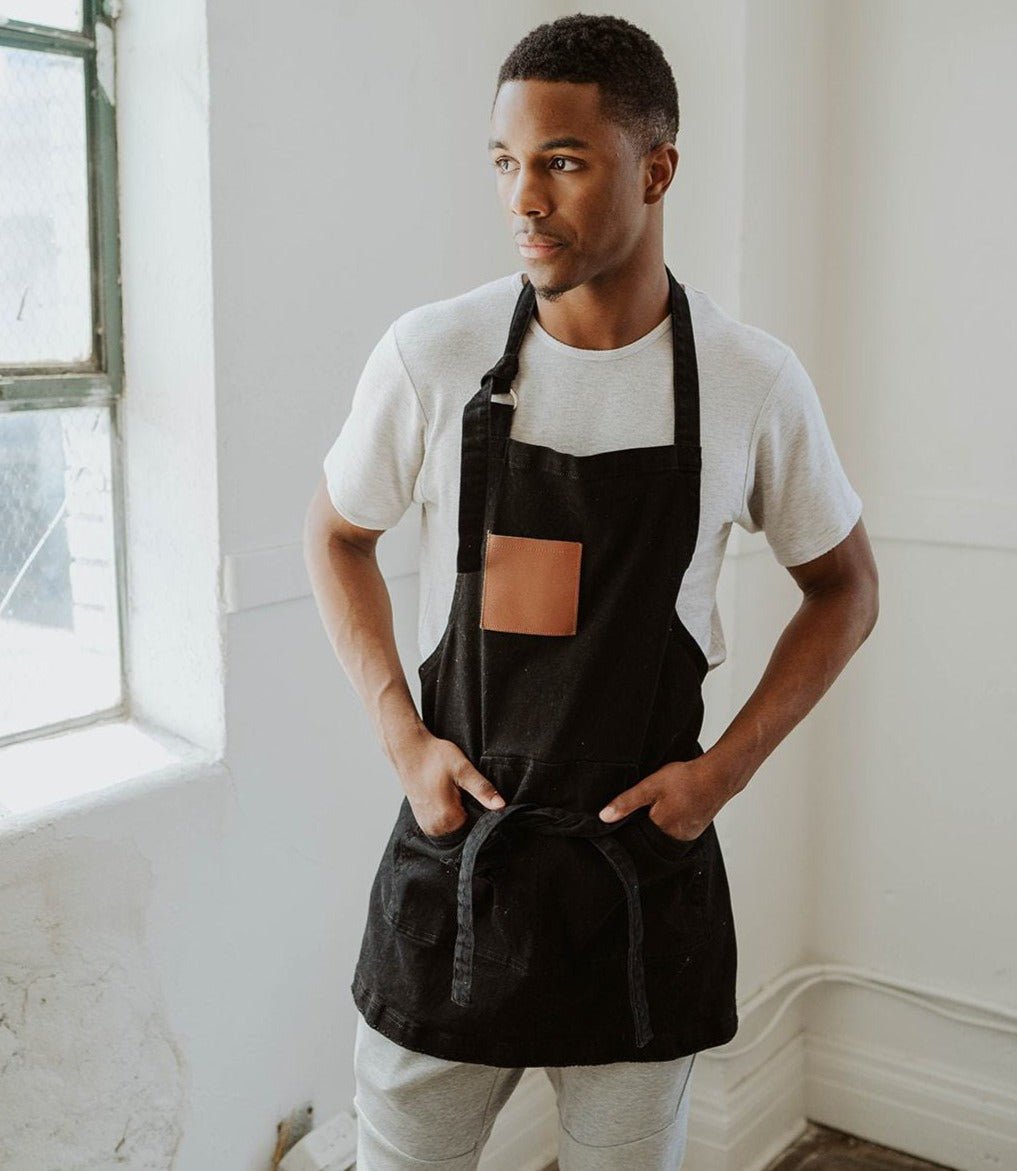
The cross-back design (signature to J. Clark Designed) eliminates neck strain entirely by anchoring at the shoulders and upper back. During break-in, you'll notice the straps settle into a custom fit — tighter users can cinch them shorter, broader frames can let them out, and the apron still sits at the same professional height on everyone.
Maintaining a Broken-In Leather Apron
Once your vegan leather apron is broken in, maintenance is minimal. This is why colorists, barbers, and tattoo artists choose it over fabric: zero laundry, zero staining, zero fuss.
- After every shift: Wipe the apron with a damp microfiber cloth or baby wipe. Bleach, toner, hair color, ink — all of it comes off on contact. Dry with a towel if needed.
- Weekly: Check the straps and waist tie for any residue buildup. Wipe them down. The adjustable hardware (metal or reinforced loops) should move freely.
- Monthly: Inspect the stitching at the pockets and straps. J. Clark aprons are reinforced at stress points, but if you carry heavy clippers or shears daily, a quick visual check ensures nothing is fraying.
No washing machine. No dry cleaner. No special products. The apron is ready to wear again the moment you wipe it down.
How Long Does a Broken-In Leather Apron Last?
A properly broken-in and maintained vegan leather apron from J. Clark Designed lasts 3–5+ years of daily professional use. Stylists report the material becomes more comfortable over time as it conforms to their body, and the bleach-proof coating never degrades — even after thousands of color services.
Compare that to fabric aprons (cotton, poly-blend, or untreated denim), which stain permanently after the first bleach spill and need replacing every 6–12 months. The higher upfront cost of a leather apron pays for itself in year one.

For High-Volume Color Work: Full Black Leather
If you're a colorist doing 8–12 services a day, the Full Black Leather apron is the workhorse. 100% bleach-proof vegan leather across the entire bib and skirt, cross-back straps, deep reinforced pockets for color brushes and foils. Wipe it clean between clients. Retail price: $99.
For Barbers and Stylists Who Want Texture: Cocoa Brown Leather
The Cocoa Brown Leather apron offers the same bleach-proof performance in a warm, professional brown tone that hides minor wear beautifully. Same cross-back straps, same wipe-clean surface, same durability. $99.
The Bottom Line
Breaking in a leather apron — specifically a vegan leather salon apron designed for bleach and chemical resistance — is simple: wear it, move in it, and let your body heat and natural motion do the work. Avoid conditioners, oils, and forced creases. Wipe it clean after every shift. Within a week, the apron will feel custom-fitted, and it will stay that way for years.
J. Clark Designed's 100% bleach-proof vegan leather aprons are engineered to repel stains on contact, not absorb them. That's the advantage. Treat the material like the performance fabric it is — not like traditional hide — and you'll get a decade-plus of reliable, professional use.
One size fits all. Free shipping. 4.8 stars from 1,444+ verified reviews. Trusted by 10,000+ salons, barbershops, and studios.
FAQ
Do I need to condition a vegan leather apron?
No. Vegan leather is a sealed synthetic material designed to repel liquids, including oils and conditioners. Applying leather conditioner will leave residue that attracts stains and reduces the apron's bleach-proof performance. Simply wipe it clean with a damp cloth after each use.
How long does it take to break in a salon apron?
A vegan leather salon apron breaks in within 5–7 days of normal wear. The material softens at natural flex points (waist, shoulders, pockets) as you move and load it with tools. Organic cotton stretch denim aprons (like J. Clark's Olive Green or Navy Pinstripe styles) are soft from day one and improve with each wash.
Can I machine wash a leather apron to speed up break-in?
Never machine wash a vegan leather apron. It will damage the bleach-proof coating and warp the material. J. Clark's 100% organic cotton stretch denim aprons (Olive Green, Terracotta, Pure Black Distressed, etc.) are machine washable and designed to soften with each wash, but the leather styles are wipe-clean only.
Will a leather apron crack if I don't break it in properly?
High-quality vegan leather aprons — like those from J. Clark Designed — are engineered to flex without cracking when broken in through normal wear. Forcing sharp creases, applying heat, or storing the apron crumpled can stress the coating and lead to premature wear. Hang it between shifts and let natural movement create the flex points.
Explore the full collection at J. Clark Designed.
```

%20over%20the%20first%20week%20while%20doing%20light%20tasks,%20allowing%20the%20vegan%20leather%20to%20conform...)
Leave a comment
This site is protected by hCaptcha and the hCaptcha Privacy Policy and Terms of Service apply.