
How do you choose the right barber apron?
**Quick Answer:** Choose a barber apron based on three critical factors: strap design (cross-back distributes weight better than neck straps), pocket configuration (deep enough for shears, combs, and clips without items shifting), and material durability (organic cotton denim or canvas with genuine leather accents withstands daily salon use and gets better with age). The right apron should feel like an extension of your craft, not a burden you tolerate.
 ## Why Most Barbers Get This Wrong
Walk into any supply shop and you'll find racks of cheap polyester aprons with thin neck straps and shallow pockets. After eight hours behind the chair, that neck strap digs into your cervical vertebrae. Your shears shift every time you bend forward. The fabric pills after three washes.
You didn't spend years perfecting your craft to wear equipment that fights you all day.
The difference between a functional apron and one that actively improves your workday comes down to engineering—weight distribution, material science, and pocket geometry designed around actual barbering movements.
## The Cross-Back Advantage: Basic Physics Applied to Your Body
Neck-strap aprons create a single pressure point that bears the full weight of the apron plus everything in your pockets. Over an eight-hour shift, that's 8-12 ounces concentrated on your C7 vertebra and trapezius muscles. The result: neck tension, shoulder pain, and that characteristic forward head posture barbers develop.
Cross-back straps distribute that same weight across your entire shoulder girdle. The load spreads from your deltoids across your scapular stabilizers. Your spine stays neutral. You're not subconsciously hunching forward to relieve pressure.
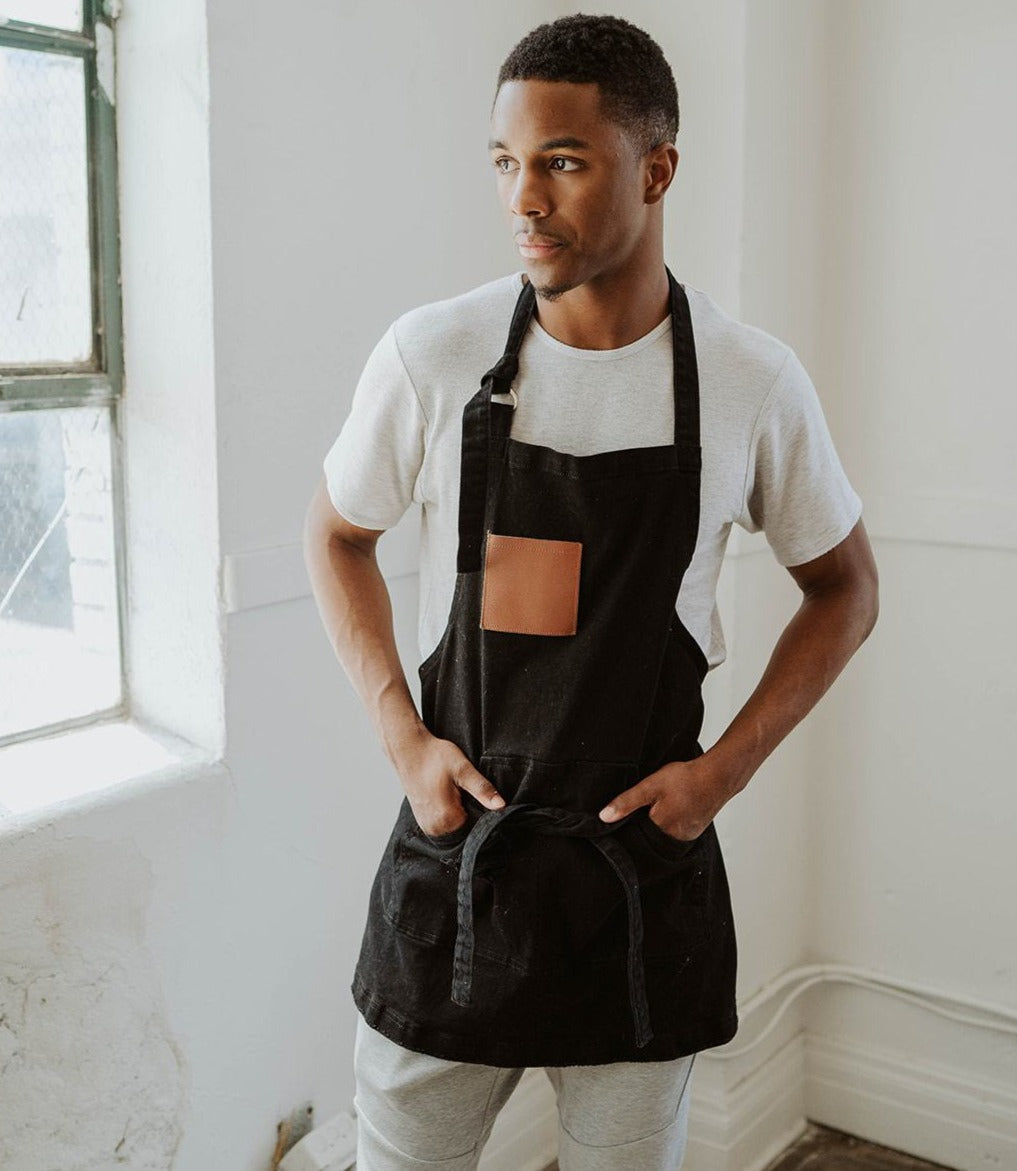
J. Clark Designed builds every apron with adjustable cross-back straps as standard—not an upgrade, not optional. The brass hardware adjusts to your exact torso length, whether you're 5'4" or 6'3". This isn't comfort, it's occupational health.
The adjustment matters more than you'd think. An apron that rides too high restricts shoulder movement when you're working around the back of the head. Too low and it doesn't protect your clothes from loose hair and product. The sweet spot sits just below your natural waist, with straps that cross between your shoulder blades—not at your neck, not at your lower back.
## Pocket Engineering: Where Most Aprons Fail Immediately
Generic aprons treat pockets as an afterthought—sewn-on patches barely deep enough for a comb. Professional barbers need pockets engineered around specific tools.
**What to measure:**
- **Depth:** Your longest shears plus one inch. Standard 6.5-inch shears need 7.5-inch minimum pocket depth so the handles sit below the pocket edge. Anything shallower and they tip forward when you bend.
- **Width:** Each pocket should accommodate your hand plus the tool. You're not playing Operation—you shouldn't have to fish for your clipper guards.
- **Reinforcement:** High-wear points at pocket corners need bar tacks or metal rivets. Check this before you buy.
The front pockets on quality barber aprons (like J. Clark Designed's Black & Leather or Denim styles) go 8+ inches deep with reinforced stitching at stress points. This isn't luxury—it's the difference between tools that stay put and constant readjustment.
Separate smaller pockets for clips, guards, and pens keep your workspace organized. When you reach for your #2 guard mid-fade, you're not digging through a jumbled pocket. Muscle memory takes over.
## Why Most Barbers Get This Wrong
Walk into any supply shop and you'll find racks of cheap polyester aprons with thin neck straps and shallow pockets. After eight hours behind the chair, that neck strap digs into your cervical vertebrae. Your shears shift every time you bend forward. The fabric pills after three washes.
You didn't spend years perfecting your craft to wear equipment that fights you all day.
The difference between a functional apron and one that actively improves your workday comes down to engineering—weight distribution, material science, and pocket geometry designed around actual barbering movements.
## The Cross-Back Advantage: Basic Physics Applied to Your Body
Neck-strap aprons create a single pressure point that bears the full weight of the apron plus everything in your pockets. Over an eight-hour shift, that's 8-12 ounces concentrated on your C7 vertebra and trapezius muscles. The result: neck tension, shoulder pain, and that characteristic forward head posture barbers develop.
Cross-back straps distribute that same weight across your entire shoulder girdle. The load spreads from your deltoids across your scapular stabilizers. Your spine stays neutral. You're not subconsciously hunching forward to relieve pressure.
J. Clark Designed builds every apron with adjustable cross-back straps as standard—not an upgrade, not optional. The brass hardware adjusts to your exact torso length, whether you're 5'4" or 6'3". This isn't comfort, it's occupational health.
The adjustment matters more than you'd think. An apron that rides too high restricts shoulder movement when you're working around the back of the head. Too low and it doesn't protect your clothes from loose hair and product. The sweet spot sits just below your natural waist, with straps that cross between your shoulder blades—not at your neck, not at your lower back.
## Pocket Engineering: Where Most Aprons Fail Immediately
Generic aprons treat pockets as an afterthought—sewn-on patches barely deep enough for a comb. Professional barbers need pockets engineered around specific tools.
**What to measure:**
- **Depth:** Your longest shears plus one inch. Standard 6.5-inch shears need 7.5-inch minimum pocket depth so the handles sit below the pocket edge. Anything shallower and they tip forward when you bend.
- **Width:** Each pocket should accommodate your hand plus the tool. You're not playing Operation—you shouldn't have to fish for your clipper guards.
- **Reinforcement:** High-wear points at pocket corners need bar tacks or metal rivets. Check this before you buy.
The front pockets on quality barber aprons (like J. Clark Designed's Black & Leather or Denim styles) go 8+ inches deep with reinforced stitching at stress points. This isn't luxury—it's the difference between tools that stay put and constant readjustment.
Separate smaller pockets for clips, guards, and pens keep your workspace organized. When you reach for your #2 guard mid-fade, you're not digging through a jumbled pocket. Muscle memory takes over.
 ## Material Selection: What Actually Holds Up
**Organic cotton denim (10-12 oz weight):** The professional standard. Heavy enough to resist hair embedding in the weave, soft enough to move with your body. Machine washable. Gets better with each wash—the fabric softens while maintaining structure. Expect 3-5 years of daily use before you see significant wear.
**Canvas (similar weight):** Slightly stiffer than denim initially, but equally durable. Some barbers prefer the crisper drape. Same washing and longevity characteristics.
**Genuine leather accents:** Not decoration—functional reinforcement at high-wear zones like pocket edges and strap attachment points. Full-grain leather develops a patina over time. Wipe clean with a damp cloth; it doesn't need washing.
**Brass or copper hardware:** Resists corrosion from cleaning products, water, and the acids in your skin. Won't rust like nickel-plated steel alternatives common in cheap aprons.
**What to avoid:** Polyester blends (don't breathe, pill immediately), thin cotton under 8 oz (won't last six months of daily washing), plastic hardware (breaks), and anything described as "water-resistant coating" (wears off after 10 washes).
The material should age gracefully. Organic cotton denim softens into a custom fit. Leather darkens and molds to your body. You're not replacing this in a year—you're breaking it in.
## Length and Coverage: Matching Your Work Style
**Three-quarter length (typical 27-32 inches from neck to hem):** Covers from chest to mid-thigh. Standard for most barbers. Protects your entire torso and lap when clients lean back. Still allows full leg mobility for moving around the chair.
**Full-length (34+ inches):** Better coverage if you work primarily standing and want maximum protection. Can feel restrictive when sitting to do detail work. Consider your typical stance.
**Chest to waist (shorter styles):** Popular with barbers who prefer minimalist gear. Less coverage, easier movement, but you're more exposed to hair and product. Usually better for beard work than full haircuts.
Your height matters. A 32-inch apron on someone 5'6" provides different coverage than the same apron on someone 6'2". Most quality manufacturers provide length measurements from shoulder to hem, not just "one size fits all."
## Style Considerations That Actually Matter
You represent your brand the second a client sits in your chair. Your apron is part of that visual identity.
**Classic black (with leather accents):** Never looks dated. Hides stains between washes. Professional across all shop aesthetics from vintage to modern. J. Clark Designed's Black & Leather style has been their bestseller for this reason—it works everywhere.
**Denim tones (indigo, black, or raw):** Nods to traditional barbering heritage. Shows intentional wear patterns over time (whiskers, honeycombs) that signal craftsmanship. Pairs well with exposed brick and reclaimed wood aesthetics.
**Statement patterns (camo, leopard, pinstripe):** If your shop has a specific vibe or you're building a personal brand on social media, patterns create visual recognition. Black Camo and Leopard Two Tone styles work in edgier, streetwear-influenced shops.
**Earthy tones (olive, cranberry, peach, rustic):** Warmer, more approachable feeling. Works well in shops that skew toward classic menswear or want to soften traditional barbershop masculinity.
The pattern should enhance your brand, not distract from your work. Avoid anything so busy that it pulls focus during client consultations.
## Material Selection: What Actually Holds Up
**Organic cotton denim (10-12 oz weight):** The professional standard. Heavy enough to resist hair embedding in the weave, soft enough to move with your body. Machine washable. Gets better with each wash—the fabric softens while maintaining structure. Expect 3-5 years of daily use before you see significant wear.
**Canvas (similar weight):** Slightly stiffer than denim initially, but equally durable. Some barbers prefer the crisper drape. Same washing and longevity characteristics.
**Genuine leather accents:** Not decoration—functional reinforcement at high-wear zones like pocket edges and strap attachment points. Full-grain leather develops a patina over time. Wipe clean with a damp cloth; it doesn't need washing.
**Brass or copper hardware:** Resists corrosion from cleaning products, water, and the acids in your skin. Won't rust like nickel-plated steel alternatives common in cheap aprons.
**What to avoid:** Polyester blends (don't breathe, pill immediately), thin cotton under 8 oz (won't last six months of daily washing), plastic hardware (breaks), and anything described as "water-resistant coating" (wears off after 10 washes).
The material should age gracefully. Organic cotton denim softens into a custom fit. Leather darkens and molds to your body. You're not replacing this in a year—you're breaking it in.
## Length and Coverage: Matching Your Work Style
**Three-quarter length (typical 27-32 inches from neck to hem):** Covers from chest to mid-thigh. Standard for most barbers. Protects your entire torso and lap when clients lean back. Still allows full leg mobility for moving around the chair.
**Full-length (34+ inches):** Better coverage if you work primarily standing and want maximum protection. Can feel restrictive when sitting to do detail work. Consider your typical stance.
**Chest to waist (shorter styles):** Popular with barbers who prefer minimalist gear. Less coverage, easier movement, but you're more exposed to hair and product. Usually better for beard work than full haircuts.
Your height matters. A 32-inch apron on someone 5'6" provides different coverage than the same apron on someone 6'2". Most quality manufacturers provide length measurements from shoulder to hem, not just "one size fits all."
## Style Considerations That Actually Matter
You represent your brand the second a client sits in your chair. Your apron is part of that visual identity.
**Classic black (with leather accents):** Never looks dated. Hides stains between washes. Professional across all shop aesthetics from vintage to modern. J. Clark Designed's Black & Leather style has been their bestseller for this reason—it works everywhere.
**Denim tones (indigo, black, or raw):** Nods to traditional barbering heritage. Shows intentional wear patterns over time (whiskers, honeycombs) that signal craftsmanship. Pairs well with exposed brick and reclaimed wood aesthetics.
**Statement patterns (camo, leopard, pinstripe):** If your shop has a specific vibe or you're building a personal brand on social media, patterns create visual recognition. Black Camo and Leopard Two Tone styles work in edgier, streetwear-influenced shops.
**Earthy tones (olive, cranberry, peach, rustic):** Warmer, more approachable feeling. Works well in shops that skew toward classic menswear or want to soften traditional barbershop masculinity.
The pattern should enhance your brand, not distract from your work. Avoid anything so busy that it pulls focus during client consultations.
 ## Care and Longevity: What Breaking In Actually Means
Quality aprons improve with use, but only if you maintain them correctly.
**Washing denim/canvas styles:**
- Machine wash cold, tumble dry low
- Wash after every 2-3 full days of use (or immediately if you get product buildup)
- The fabric will soften significantly after 5-10 washes
- Expect slight shrinkage (1-2%) in the first few washes—factor this in if you're between sizes
**Leather care:**
- Wipe with damp cloth after each shift to remove hair and product
- Condition every 3-4 months with leather conditioner (not mink oil—too heavy)
- Light scratches and color variation are normal and add character
- Never put leather in the washing machine
**Hardware maintenance:**
- Brass naturally darkens—this is patina, not damage
- If adjusters get stiff, work a drop of mineral oil into the mechanism
- Check stitching at stress points every few months; catch loose threads early
A well-maintained apron from a quality maker should last 3-5 years of daily professional use. You're looking at roughly 1,200-1,500 wear cycles before you see significant structural degradation.
Compare that to cheap alternatives that need replacing every 8-12 months. The math favors quality even on pure economics, before you factor in comfort and professional appearance.
## Price vs. Value: The Real Cost Analysis
Entry-level aprons: $20-35. Expected lifespan: 6-12 months. Cost per year: $20-70.
Professional-grade aprons: $58-128. Expected lifespan: 3-5 years. Cost per year: $12-43.
The professional option is literally cheaper per year while delivering significantly better ergonomics and appearance. This isn't a splurge—it's the smarter financial decision.
Factor in the hidden costs of cheap aprons: neck pain leading to reduced productivity, tools falling out of shallow pockets (lost time), unprofessional appearance affecting client perception (lost bookings). The true cost differential is even wider.
J. Clark Designed aprons range from $58 for classic Denim styles to $128 for premium Black & Leather options. With over 1,444 verified reviews averaging 4.8 stars, you're buying proven equipment, not taking a chance.
## What 10,000+ Barbershops Have Learned
The aprons used in professional barbershops worldwide share common characteristics: cross-back straps, deep reinforced pockets, durable natural materials, and adjustable fit. These aren't trends—they're the features that survive real-world testing.
When barbers who've worn aprons 50+ hours per week for years keep choosing the same design elements, that's data worth trusting more than marketing claims.
The right apron becomes invisible—you forget you're wearing it. The wrong one announces itself every time you bend, reach, or shift your weight.
## The Bottom Line
Choosing the right barber apron means prioritizing cross-back strap design, pocket depth and configuration that matches your tools, and materials that improve with age rather than deteriorate. Skip the neck-strap polyester options that dominate supply shops. Invest in organic cotton denim or canvas with genuine leather reinforcement, brass hardware, and construction designed for 1,000+ wear cycles.
Your apron should feel like professional equipment, not a disposable uniform piece. The difference shows in your posture at the end of a long day, the organization of your workspace, and the image you project to every client.
## FAQ
**How long should a quality barber apron last?**
With proper care, expect 3-5 years of daily professional use from well-constructed aprons using organic cotton denim and genuine leather accents. Cheap alternatives typically need replacement every 6-12 months. The key is regular washing, proper drying, and checking stress points for early wear.
**Do cross-back straps really make a difference for neck and shoulder pain?**
Yes—significantly. Cross-back designs distribute apron weight across your entire shoulder girdle instead of concentrating pressure on your C7 vertebra and trapezius muscles. Barbers consistently report reduced neck tension and better posture after switching from neck-strap to cross-back styles, particularly during long shifts.
**Can you wash barber aprons with leather accents?**
Organic cotton denim and canvas portions are machine washable (cold wash, low tumble dry). Wipe leather accents with a damp cloth after each shift and condition every 3-4 months—never put leather through a washing machine. The leather develops a natural patina over time, which adds character rather than indicating damage.
**What pocket depth do professional barbers actually need?**
Minimum 7.5 inches to properly hold 6.5-inch shears without tips protruding or handles catching when you bend. Professional-grade aprons typically feature 8+ inch pockets with reinforced stitching at corners. Separate smaller compartments for guards, clips, and combs prevent tool jumble and speed up your workflow.
Explore the full collection at [J. Clark Designed](https://www.jclarkdesigned.com/collections/all)
## Care and Longevity: What Breaking In Actually Means
Quality aprons improve with use, but only if you maintain them correctly.
**Washing denim/canvas styles:**
- Machine wash cold, tumble dry low
- Wash after every 2-3 full days of use (or immediately if you get product buildup)
- The fabric will soften significantly after 5-10 washes
- Expect slight shrinkage (1-2%) in the first few washes—factor this in if you're between sizes
**Leather care:**
- Wipe with damp cloth after each shift to remove hair and product
- Condition every 3-4 months with leather conditioner (not mink oil—too heavy)
- Light scratches and color variation are normal and add character
- Never put leather in the washing machine
**Hardware maintenance:**
- Brass naturally darkens—this is patina, not damage
- If adjusters get stiff, work a drop of mineral oil into the mechanism
- Check stitching at stress points every few months; catch loose threads early
A well-maintained apron from a quality maker should last 3-5 years of daily professional use. You're looking at roughly 1,200-1,500 wear cycles before you see significant structural degradation.
Compare that to cheap alternatives that need replacing every 8-12 months. The math favors quality even on pure economics, before you factor in comfort and professional appearance.
## Price vs. Value: The Real Cost Analysis
Entry-level aprons: $20-35. Expected lifespan: 6-12 months. Cost per year: $20-70.
Professional-grade aprons: $58-128. Expected lifespan: 3-5 years. Cost per year: $12-43.
The professional option is literally cheaper per year while delivering significantly better ergonomics and appearance. This isn't a splurge—it's the smarter financial decision.
Factor in the hidden costs of cheap aprons: neck pain leading to reduced productivity, tools falling out of shallow pockets (lost time), unprofessional appearance affecting client perception (lost bookings). The true cost differential is even wider.
J. Clark Designed aprons range from $58 for classic Denim styles to $128 for premium Black & Leather options. With over 1,444 verified reviews averaging 4.8 stars, you're buying proven equipment, not taking a chance.
## What 10,000+ Barbershops Have Learned
The aprons used in professional barbershops worldwide share common characteristics: cross-back straps, deep reinforced pockets, durable natural materials, and adjustable fit. These aren't trends—they're the features that survive real-world testing.
When barbers who've worn aprons 50+ hours per week for years keep choosing the same design elements, that's data worth trusting more than marketing claims.
The right apron becomes invisible—you forget you're wearing it. The wrong one announces itself every time you bend, reach, or shift your weight.
## The Bottom Line
Choosing the right barber apron means prioritizing cross-back strap design, pocket depth and configuration that matches your tools, and materials that improve with age rather than deteriorate. Skip the neck-strap polyester options that dominate supply shops. Invest in organic cotton denim or canvas with genuine leather reinforcement, brass hardware, and construction designed for 1,000+ wear cycles.
Your apron should feel like professional equipment, not a disposable uniform piece. The difference shows in your posture at the end of a long day, the organization of your workspace, and the image you project to every client.
## FAQ
**How long should a quality barber apron last?**
With proper care, expect 3-5 years of daily professional use from well-constructed aprons using organic cotton denim and genuine leather accents. Cheap alternatives typically need replacement every 6-12 months. The key is regular washing, proper drying, and checking stress points for early wear.
**Do cross-back straps really make a difference for neck and shoulder pain?**
Yes—significantly. Cross-back designs distribute apron weight across your entire shoulder girdle instead of concentrating pressure on your C7 vertebra and trapezius muscles. Barbers consistently report reduced neck tension and better posture after switching from neck-strap to cross-back styles, particularly during long shifts.
**Can you wash barber aprons with leather accents?**
Organic cotton denim and canvas portions are machine washable (cold wash, low tumble dry). Wipe leather accents with a damp cloth after each shift and condition every 3-4 months—never put leather through a washing machine. The leather develops a natural patina over time, which adds character rather than indicating damage.
**What pocket depth do professional barbers actually need?**
Minimum 7.5 inches to properly hold 6.5-inch shears without tips protruding or handles catching when you bend. Professional-grade aprons typically feature 8+ inch pockets with reinforced stitching at corners. Separate smaller compartments for guards, clips, and combs prevent tool jumble and speed up your workflow.
Explore the full collection at [J. Clark Designed](https://www.jclarkdesigned.com/collections/all)
## Why Most Barbers Get This Wrong
Walk into any supply shop and you'll find racks of cheap polyester aprons with thin neck straps and shallow pockets. After eight hours behind the chair, that neck strap digs into your cervical vertebrae. Your shears shift every time you bend forward. The fabric pills after three washes.
You didn't spend years perfecting your craft to wear equipment that fights you all day.
The difference between a functional apron and one that actively improves your workday comes down to engineering—weight distribution, material science, and pocket geometry designed around actual barbering movements.
## The Cross-Back Advantage: Basic Physics Applied to Your Body
Neck-strap aprons create a single pressure point that bears the full weight of the apron plus everything in your pockets. Over an eight-hour shift, that's 8-12 ounces concentrated on your C7 vertebra and trapezius muscles. The result: neck tension, shoulder pain, and that characteristic forward head posture barbers develop.
Cross-back straps distribute that same weight across your entire shoulder girdle. The load spreads from your deltoids across your scapular stabilizers. Your spine stays neutral. You're not subconsciously hunching forward to relieve pressure.
J. Clark Designed builds every apron with adjustable cross-back straps as standard—not an upgrade, not optional. The brass hardware adjusts to your exact torso length, whether you're 5'4" or 6'3". This isn't comfort, it's occupational health.
The adjustment matters more than you'd think. An apron that rides too high restricts shoulder movement when you're working around the back of the head. Too low and it doesn't protect your clothes from loose hair and product. The sweet spot sits just below your natural waist, with straps that cross between your shoulder blades—not at your neck, not at your lower back.
## Pocket Engineering: Where Most Aprons Fail Immediately
Generic aprons treat pockets as an afterthought—sewn-on patches barely deep enough for a comb. Professional barbers need pockets engineered around specific tools.
**What to measure:**
- **Depth:** Your longest shears plus one inch. Standard 6.5-inch shears need 7.5-inch minimum pocket depth so the handles sit below the pocket edge. Anything shallower and they tip forward when you bend.
- **Width:** Each pocket should accommodate your hand plus the tool. You're not playing Operation—you shouldn't have to fish for your clipper guards.
- **Reinforcement:** High-wear points at pocket corners need bar tacks or metal rivets. Check this before you buy.
The front pockets on quality barber aprons (like J. Clark Designed's Black & Leather or Denim styles) go 8+ inches deep with reinforced stitching at stress points. This isn't luxury—it's the difference between tools that stay put and constant readjustment.
Separate smaller pockets for clips, guards, and pens keep your workspace organized. When you reach for your #2 guard mid-fade, you're not digging through a jumbled pocket. Muscle memory takes over.
## Material Selection: What Actually Holds Up
**Organic cotton denim (10-12 oz weight):** The professional standard. Heavy enough to resist hair embedding in the weave, soft enough to move with your body. Machine washable. Gets better with each wash—the fabric softens while maintaining structure. Expect 3-5 years of daily use before you see significant wear.
**Canvas (similar weight):** Slightly stiffer than denim initially, but equally durable. Some barbers prefer the crisper drape. Same washing and longevity characteristics.
**Genuine leather accents:** Not decoration—functional reinforcement at high-wear zones like pocket edges and strap attachment points. Full-grain leather develops a patina over time. Wipe clean with a damp cloth; it doesn't need washing.
**Brass or copper hardware:** Resists corrosion from cleaning products, water, and the acids in your skin. Won't rust like nickel-plated steel alternatives common in cheap aprons.
**What to avoid:** Polyester blends (don't breathe, pill immediately), thin cotton under 8 oz (won't last six months of daily washing), plastic hardware (breaks), and anything described as "water-resistant coating" (wears off after 10 washes).
The material should age gracefully. Organic cotton denim softens into a custom fit. Leather darkens and molds to your body. You're not replacing this in a year—you're breaking it in.
## Length and Coverage: Matching Your Work Style
**Three-quarter length (typical 27-32 inches from neck to hem):** Covers from chest to mid-thigh. Standard for most barbers. Protects your entire torso and lap when clients lean back. Still allows full leg mobility for moving around the chair.
**Full-length (34+ inches):** Better coverage if you work primarily standing and want maximum protection. Can feel restrictive when sitting to do detail work. Consider your typical stance.
**Chest to waist (shorter styles):** Popular with barbers who prefer minimalist gear. Less coverage, easier movement, but you're more exposed to hair and product. Usually better for beard work than full haircuts.
Your height matters. A 32-inch apron on someone 5'6" provides different coverage than the same apron on someone 6'2". Most quality manufacturers provide length measurements from shoulder to hem, not just "one size fits all."
## Style Considerations That Actually Matter
You represent your brand the second a client sits in your chair. Your apron is part of that visual identity.
**Classic black (with leather accents):** Never looks dated. Hides stains between washes. Professional across all shop aesthetics from vintage to modern. J. Clark Designed's Black & Leather style has been their bestseller for this reason—it works everywhere.
**Denim tones (indigo, black, or raw):** Nods to traditional barbering heritage. Shows intentional wear patterns over time (whiskers, honeycombs) that signal craftsmanship. Pairs well with exposed brick and reclaimed wood aesthetics.
**Statement patterns (camo, leopard, pinstripe):** If your shop has a specific vibe or you're building a personal brand on social media, patterns create visual recognition. Black Camo and Leopard Two Tone styles work in edgier, streetwear-influenced shops.
**Earthy tones (olive, cranberry, peach, rustic):** Warmer, more approachable feeling. Works well in shops that skew toward classic menswear or want to soften traditional barbershop masculinity.
The pattern should enhance your brand, not distract from your work. Avoid anything so busy that it pulls focus during client consultations.
## Care and Longevity: What Breaking In Actually Means
Quality aprons improve with use, but only if you maintain them correctly.
**Washing denim/canvas styles:**
- Machine wash cold, tumble dry low
- Wash after every 2-3 full days of use (or immediately if you get product buildup)
- The fabric will soften significantly after 5-10 washes
- Expect slight shrinkage (1-2%) in the first few washes—factor this in if you're between sizes
**Leather care:**
- Wipe with damp cloth after each shift to remove hair and product
- Condition every 3-4 months with leather conditioner (not mink oil—too heavy)
- Light scratches and color variation are normal and add character
- Never put leather in the washing machine
**Hardware maintenance:**
- Brass naturally darkens—this is patina, not damage
- If adjusters get stiff, work a drop of mineral oil into the mechanism
- Check stitching at stress points every few months; catch loose threads early
A well-maintained apron from a quality maker should last 3-5 years of daily professional use. You're looking at roughly 1,200-1,500 wear cycles before you see significant structural degradation.
Compare that to cheap alternatives that need replacing every 8-12 months. The math favors quality even on pure economics, before you factor in comfort and professional appearance.
## Price vs. Value: The Real Cost Analysis
Entry-level aprons: $20-35. Expected lifespan: 6-12 months. Cost per year: $20-70.
Professional-grade aprons: $58-128. Expected lifespan: 3-5 years. Cost per year: $12-43.
The professional option is literally cheaper per year while delivering significantly better ergonomics and appearance. This isn't a splurge—it's the smarter financial decision.
Factor in the hidden costs of cheap aprons: neck pain leading to reduced productivity, tools falling out of shallow pockets (lost time), unprofessional appearance affecting client perception (lost bookings). The true cost differential is even wider.
J. Clark Designed aprons range from $58 for classic Denim styles to $128 for premium Black & Leather options. With over 1,444 verified reviews averaging 4.8 stars, you're buying proven equipment, not taking a chance.
## What 10,000+ Barbershops Have Learned
The aprons used in professional barbershops worldwide share common characteristics: cross-back straps, deep reinforced pockets, durable natural materials, and adjustable fit. These aren't trends—they're the features that survive real-world testing.
When barbers who've worn aprons 50+ hours per week for years keep choosing the same design elements, that's data worth trusting more than marketing claims.
The right apron becomes invisible—you forget you're wearing it. The wrong one announces itself every time you bend, reach, or shift your weight.
## The Bottom Line
Choosing the right barber apron means prioritizing cross-back strap design, pocket depth and configuration that matches your tools, and materials that improve with age rather than deteriorate. Skip the neck-strap polyester options that dominate supply shops. Invest in organic cotton denim or canvas with genuine leather reinforcement, brass hardware, and construction designed for 1,000+ wear cycles.
Your apron should feel like professional equipment, not a disposable uniform piece. The difference shows in your posture at the end of a long day, the organization of your workspace, and the image you project to every client.
## FAQ
**How long should a quality barber apron last?**
With proper care, expect 3-5 years of daily professional use from well-constructed aprons using organic cotton denim and genuine leather accents. Cheap alternatives typically need replacement every 6-12 months. The key is regular washing, proper drying, and checking stress points for early wear.
**Do cross-back straps really make a difference for neck and shoulder pain?**
Yes—significantly. Cross-back designs distribute apron weight across your entire shoulder girdle instead of concentrating pressure on your C7 vertebra and trapezius muscles. Barbers consistently report reduced neck tension and better posture after switching from neck-strap to cross-back styles, particularly during long shifts.
**Can you wash barber aprons with leather accents?**
Organic cotton denim and canvas portions are machine washable (cold wash, low tumble dry). Wipe leather accents with a damp cloth after each shift and condition every 3-4 months—never put leather through a washing machine. The leather develops a natural patina over time, which adds character rather than indicating damage.
**What pocket depth do professional barbers actually need?**
Minimum 7.5 inches to properly hold 6.5-inch shears without tips protruding or handles catching when you bend. Professional-grade aprons typically feature 8+ inch pockets with reinforced stitching at corners. Separate smaller compartments for guards, clips, and combs prevent tool jumble and speed up your workflow.
Explore the full collection at [J. Clark Designed](https://www.jclarkdesigned.com/collections/all)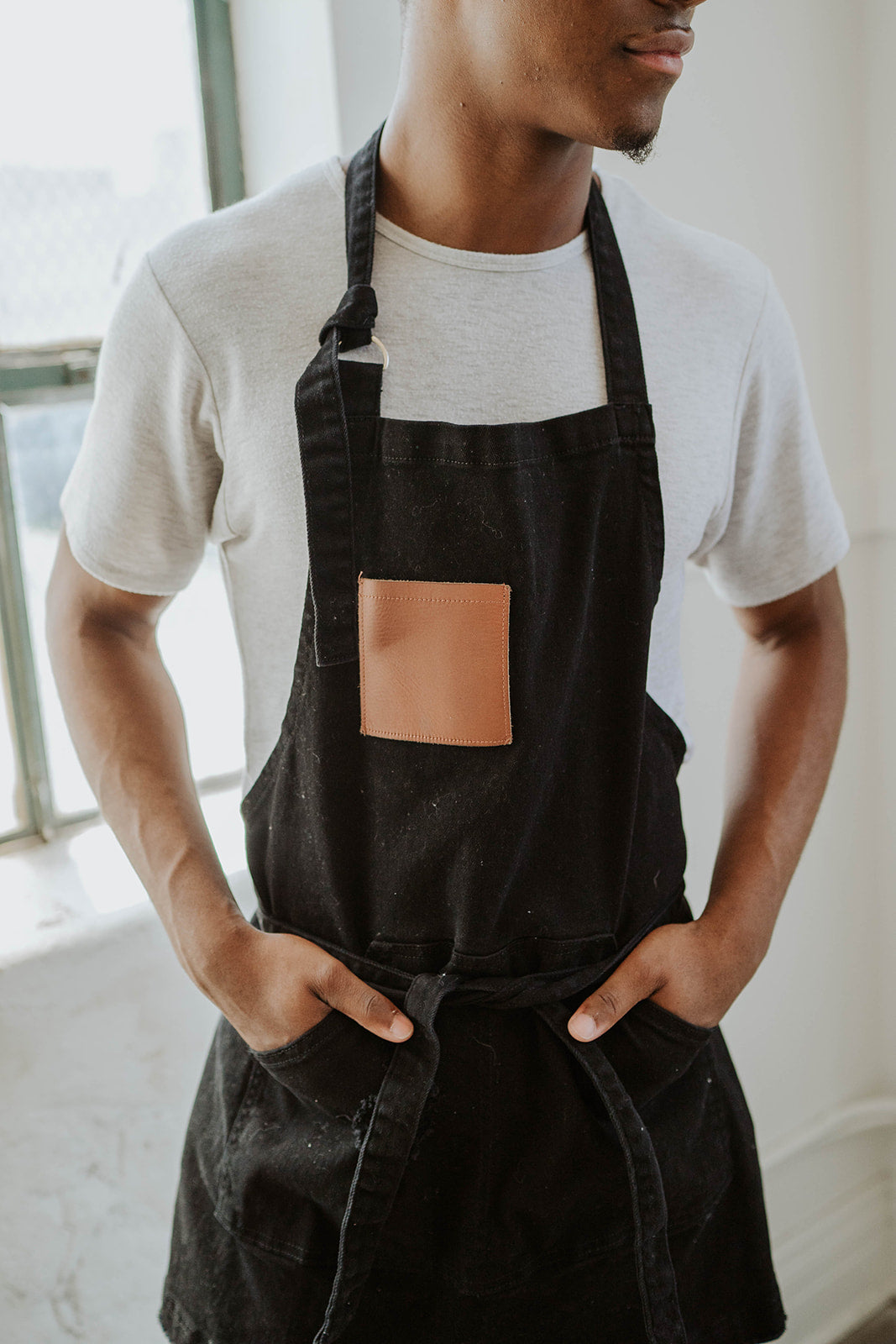

,%20pocket%20configuration%20(deep%20enough%20for%20shears,%20combs,%20a...)
Leave a comment
This site is protected by hCaptcha and the hCaptcha Privacy Policy and Terms of Service apply.