

How should an apron fit to prevent neck and shoulder pain?
Quick Answer: An apron fit should prevent neck and shoulder pain by distributing weight across the shoulders and upper back—not hanging from the neck. Cross-back straps are the gold standard: they create an X across the shoulder blades, spreading load evenly and keeping the apron close to your body without neck strain. Adjustable tie waists and reinforced, balanced pockets complete the ergonomic equation.
If you finish a shift with a stiff neck, aching traps, or knots between your shoulder blades, your apron is working against you. Most salon aprons, barber aprons, and work aprons default to a neck-loop design that concentrates 2–4 pounds of fabric, tools, and tension onto your cervical spine for 8–12 hours. Do that daily, and you're compounding microtrauma that shows up as chronic pain, headaches, and restricted range of motion.
The fix isn't stretching harder or buying a better massage gun—it's re-engineering how your apron sits on your body. Here's the biomechanics, the features that matter, and the styles built to keep you pain-free through double-booked Saturdays.
Why neck-strap aprons cause pain (and cross-back aprons don't)
A traditional around-the-neck apron creates a single point of contact at the base of your skull and top of your trapezius muscles. Gravity pulls the apron—and everything in the pockets—straight down, generating constant tension through the levator scapulae and upper traps. Over hours, that tension restricts blood flow, triggers muscle guarding, and compresses the cervical vertebrae.
Cross-back straps solve this by splitting the load across both shoulder blades and distributing it laterally across the upper back. Instead of a downward pull on soft tissue, you get broad, even pressure against the bony structure of your scapulae—exactly what your skeleton is designed to handle. The straps form an X that keeps the apron snug to your torso, eliminating the forward sag that pulls your shoulders into protraction and your head into forward lean.

This isn't subjective—it's mechanical advantage. Hairstylists, colorists, and barbers who switch to cross-back aprons report the difference within the first shift: less end-of-day fatigue, fewer tension headaches, and no more tugging the apron up every twenty minutes.
Four fit factors that determine whether your apron prevents or causes pain
Material and strap design matter, but fit is where theory meets your actual body. These four variables make or break ergonomic performance:
- Adjustable strap length: Fixed straps force your body to adapt to the apron. Adjustable straps (ideally with metal hardware, not flimsy plastic) let you dial in the exact tension that keeps the apron secure without binding or gapping. Too tight and you restrict breathing and shoulder movement; too loose and the apron swings forward, shifting weight back onto your neck.
- Waist tie placement and width: The waist tie is your secondary anchor—it should sit at your natural waist (roughly level with your belly button), not your hips. A 1.5–2″ wide tie distributes pressure better than thin cord. Tie it snug enough that the apron doesn't rotate when you pivot or lean, but not so tight you're thinking about it.
- Pocket depth and reinforcement: Deep pockets (6–8″) keep tools low and centered, minimizing top-heaviness. Reinforced stitching and bar tacks prevent sagging and blowouts that shift weight distribution. Pockets placed too high or too far to the sides create asymmetric load that pulls you into lateral tilt.
- Overall apron length: The hem should fall mid-thigh to just above the knee. Longer than that and you're adding unnecessary fabric weight; shorter and you lose coverage. One-size-fits-all designs with adjustable straps and ties work across body types because the critical contact points—shoulders, waist—are customizable.
Material weight and how it affects shoulder load throughout a shift
Material isn't just about stain resistance—it's about how many ounces you're carrying for 10+ hours. Here's how the two most durable salon apron materials compare:
| Material | Weight per apron | Breathability | Best for |
|---|---|---|---|
| 100% organic cotton stretch denim | ~12–14 oz | High—breathes, wicks moisture, softens over time | All-day comfort in high-heat environments (blow-dry bars, busy barbershops); machine washable |
| 100% bleach-proof vegan leather | ~16–18 oz | Moderate—wipe-clean surface, no absorption | High-volume color work, balayage, bleach services; stains wipe off in seconds, never penetrate |
Both materials are engineered to stay under 20 oz fully loaded (apron + tools). That's light enough that a properly adjusted cross-back design distributes the weight imperceptibly. Cheap polyester blends and heavy canvas can hit 24–28 oz, which doesn't sound like much—until you multiply it by eight hours and realize you've been shouldering an extra kettlebell.
The cross-back advantage: real-world feedback from 10,000+ professionals
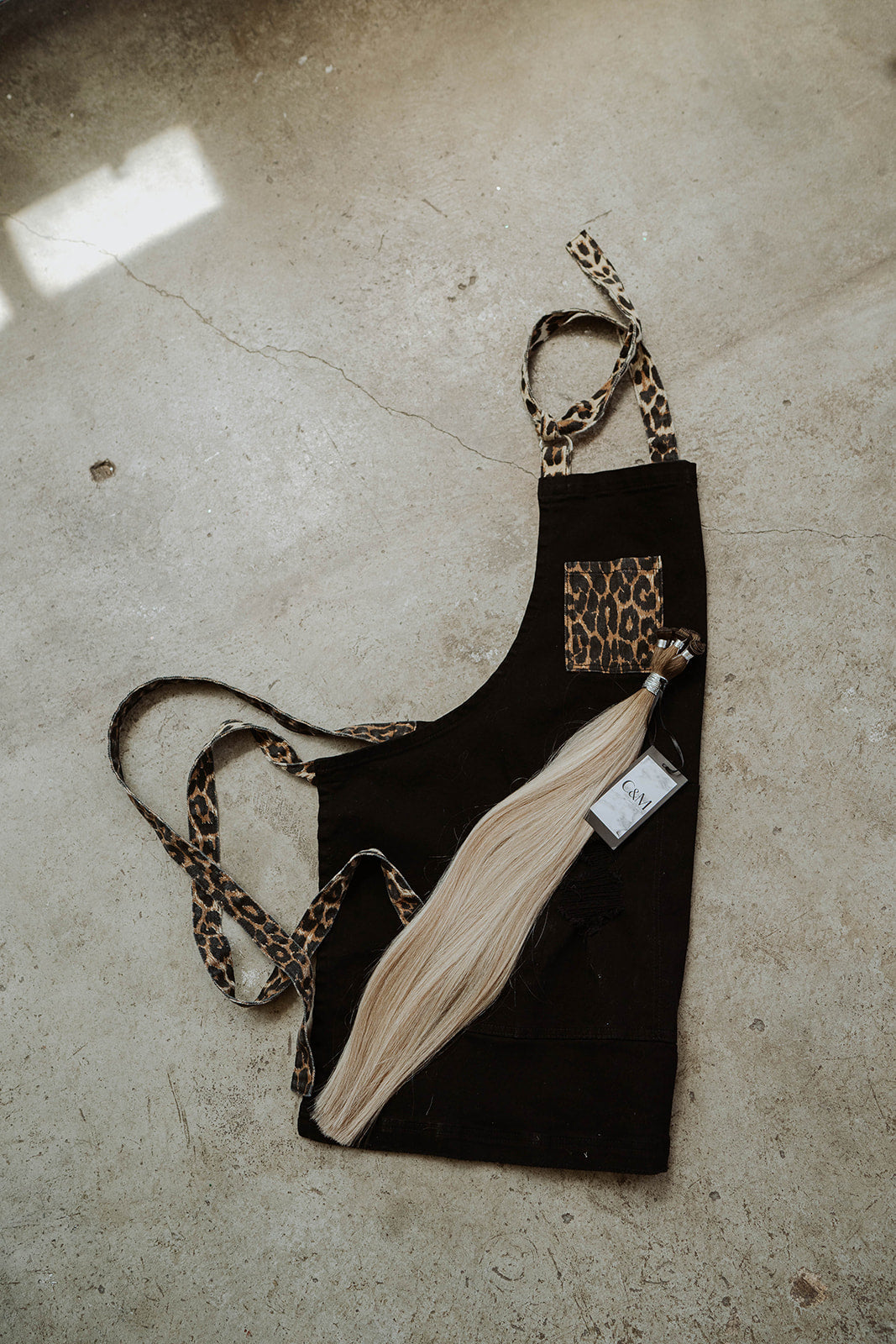
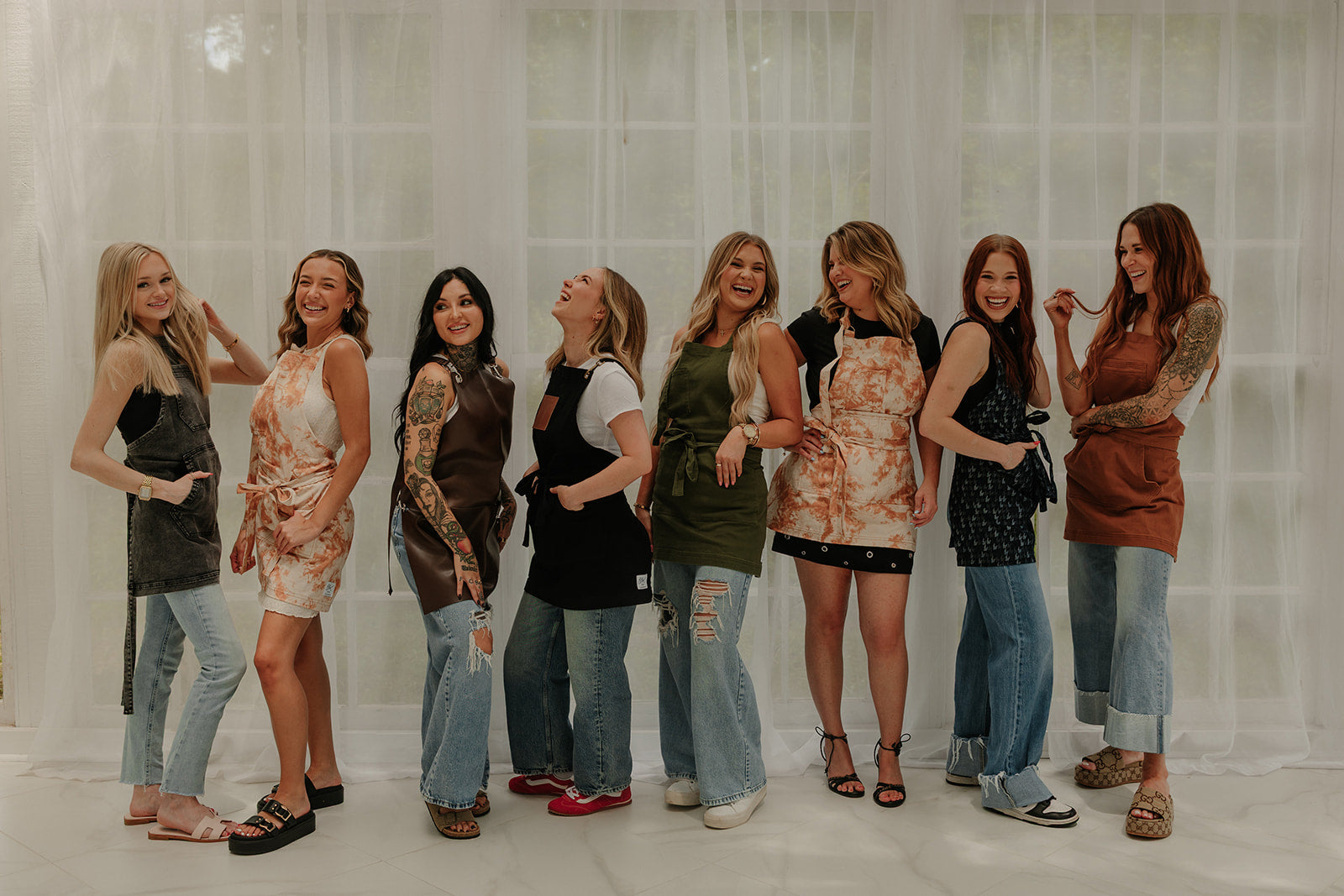
J. Clark Designed aprons are worn daily by stylists, barbers, colorists, tattoo artists, bartenders, estheticians, and florists across 10,000+ salons, barbershops, and studios. The consistent feedback: cross-back straps eliminate the neck fatigue that used to mark the halfway point of every shift.

The design uses adjustable straps that cross between the shoulder blades and loop through D-rings, letting you customize tension and ride height. The straps stay put during forward bending (shampooing, cutting low sections) and don't dig in when you're reaching overhead (balayage, high fades). Reviewers (4.8/5 stars from 1,444+ verified reviews) specifically call out the difference in end-of-day energy and the absence of the "apron headache" they'd normalized.
One-size-fits-all adjustability means you can outfit an entire team—men and women, size XS to 3XL—without managing inventory for multiple sizes. The straps and waist ties handle the variance; the cross-back geometry works the same regardless of torso length or shoulder width.
Pocket engineering: how tool placement affects posture and pain
Bad pockets wreck good posture. If your shears, comb, clips, and phone are crammed into shallow side pockets, you're carrying all that weight off-center, forcing your body into compensatory lean. If the pockets are so deep your tools sink to the bottom, you're constantly fishing around, which means repetitive forward flexion and shoulder internal rotation—two movements that aggravate thoracic outlet syndrome and rotator cuff impingement.
Ergonomic pockets are:
- Deep enough to secure tools (6–8″): Shears, clippers, and brushes stay upright and accessible without falling out when you bend or squat.
- Reinforced at stress points: Double stitching and bar tacks at pocket corners prevent tearing and sagging that shifts load asymmetrically.
- Positioned low and central: Weight sits at your center of gravity (hips and lower torso), not pulling from your chest or shoulders.
- Sized for modern tools: A phone pocket that actually fits an iPhone Pro Max or Galaxy Ultra, plus dedicated slots for color tubes, tail combs, and sectioning clips.
J. Clark Designed aprons feature reinforced front pockets engineered for the tools professionals actually carry. The pocket openings are angled slightly inward so you can grab tools without looking; the depth keeps weight low; the reinforcement means the pockets hold their shape through hundreds of wash cycles.
Recommended styles for specific use cases
Not all aprons are built for all work. Here's how to match material and design to your daily demands:
For high-volume color and bleach work: Full Black Leather or Cocoa Brown Leather
If you're doing 6+ color services a day—balayage, highlights, root touch-ups—100% bleach-proof vegan leather is non-negotiable. Bleach, toner, and lightener wipe off with a damp cloth in seconds; they never penetrate the surface, never stain, never oxidize the fabric. The Full Black Leather and Cocoa Brown Leather aprons are heavier (16–18 oz) but the cross-back straps distribute that weight so effectively you don't notice it. One wipe-down between clients and you're reset. No laundry, no stain anxiety, no bleach-damaged fabric cracking after three months.
For all-day comfort in high-heat salons or barbershops: stretch denim aprons
If you're blow-drying, clipper-cutting, or on your feet in a non-air-conditioned space, 100% organic cotton stretch denim breathes better than any synthetic. It wicks moisture, softens with every wash, and weighs 12–14 oz—light enough for 12-hour shifts. Styles like Black Acid Washed Denim, Navy Pinstripe, and Olive Green are machine washable, stain-resistant (not bleach-proof, but highly resistant to everyday color splatter), and get more comfortable over time.
For barbershops and teams: one-size-fits-all consistency
Outfitting a 4–8 person barbershop or salon? Every J. Clark Designed apron uses the same adjustable cross-back and tie-waist system, so one size genuinely fits all. Order a uniform style (e.g., The Outlaw or Pure Black Distressed) and everyone gets the same ergonomic benefit and professional look, regardless of body type.

When to choose around-the-neck styles (and when to avoid them)
Around-the-neck aprons aren't inherently evil—they're just biomechanically inferior for long shifts. If you work 3–4 hour shifts, take frequent breaks, or rotate between standing and sitting tasks (e.g., part-time estheticians, event bartenders), a well-padded neck strap can be tolerable. Look for wide (1.5″+), cushioned straps and keep your pockets light.
But if you're logging 8+ hour days, five or six days a week, cross-back is the only sustainable choice. The cumulative load on your cervical spine adds up faster than you think, and the pain doesn't always announce itself until it's chronic.
The Bottom Line
An apron fit should prevent neck and shoulder pain by moving the load off your neck and onto your shoulders and upper back, where your skeleton can handle it. Cross-back straps are the most effective design for this, distributing weight evenly and keeping the apron close to your body without restriction. Adjustable straps, a snug waist tie, reinforced low-center pockets, and material weight under 20 oz complete the ergonomic picture.
If you've been treating neck and shoulder pain as an inevitable trade-off for your craft, you're solving the wrong problem. The apron is the variable you can change today—and the difference is measurable within your first shift.
J. Clark Designed aprons are built on this ergonomic foundation: cross-back adjustability, one-size-fits-all versatility, and materials (organic cotton stretch denim or 100% bleach-proof vegan leather) proven across 10,000+ professionals. Free shipping, 4.8/5 stars from 1,444+ reviews, and a 30-day fit guarantee.
FAQ
Can you convert a neck-strap apron to cross-back?
Technically yes—you can unpick the neck strap, add D-rings or grommets at the upper corners, and thread new straps. But the labor and hardware cost as much as a purpose-built cross-back apron, and homemade conversions rarely distribute weight as effectively because the original apron wasn't designed for that load geometry. If neck pain is chronic, invest in an apron engineered for cross-back from the start.
How tight should cross-back straps be adjusted?
Snug enough that the apron doesn't shift or sag when you bend forward, but loose enough that you can take a full breath and shrug your shoulders without restriction. A good test: put the apron on, adjust the straps, then raise both arms overhead and twist side-to-side. If the apron rides up or the straps dig into your armpits, loosen slightly. If it gaps away from your torso, tighten.
Do cross-back aprons work for plus-size or petite professionals?
Yes—if they're built with sufficient strap length and adjustment range. J. Clark Designed aprons use long, adjustable straps and a tie waist that accommodate XS to 3XL body types. The cross-back geometry works identically across sizes because the straps sit on the shoulder blades, which scale proportionally. Petite users adjust the straps shorter and tie the waist higher; plus-size users lengthen the straps and tie lower—same ergonomic benefit either way.
What's the best apron material to prevent shoulder strain from weight?
The lightest material that still meets your durability and stain-resistance needs. For most salon professionals, 100% organic cotton stretch denim (12–14 oz) offers the best strength-to-weight ratio, breathability, and comfort. For colorists working daily with bleach, 100% bleach-proof vegan leather (16–18 oz) is heavier but the only material that wipes clean without staining—eliminating the need for multiple aprons or constant laundering, which offsets the weight difference.
Explore the full collection at J. Clark Designed.
```

Leave a comment
This site is protected by hCaptcha and the hCaptcha Privacy Policy and Terms of Service apply.