

Why are handcrafted aprons worth the investment over cheap alternatives?
**Quick Answer:** Handcrafted aprons deliver 3-5 years of daily professional use versus 3-6 months for mass-produced alternatives, with superior weight distribution that prevents chronic neck and shoulder pain. The real cost per wear works out to pennies when you factor in durability, ergonomic design, and materials that improve rather than deteriorate—making them significantly cheaper over time than repeatedly replacing cheap aprons.
## The Hidden Cost of "Saving Money"
That $19.99 apron from the beauty supply store seems like a smart budget move. Until it's stretched out and stained six months later. Then you buy another one. And another. By year two, you've spent $80+ on disposable gear that never fit right in the first place.
Meanwhile, the stylist working next to you invested $98 in a J. Clark Designed apron three years ago. Still wearing it daily. Still looks professional. Still protects her clothes without leaving her neck throbbing by 2 PM.
The math isn't even close when you run the actual numbers.
## Material Science: Why Construction Matters More Than Price
Mass-produced aprons use whatever fabric costs pennies per yard—typically polyester blends that repel water initially but break down under repeated washing. The stitching uses cheap thread that unravels. The straps are narrow polyester that cuts into your neck because distributing tension across minimal surface area creates pressure points.
Handcrafted aprons from manufacturers like J. Clark Designed use 10oz organic cotton denim that actually gets *better* with age. The fabric softens while maintaining structural integrity. Genuine leather accents develop a patina rather than cracking. Brass hardware won't corrode when exposed to hair chemicals, sanitizers, or the humidity of a busy salon.
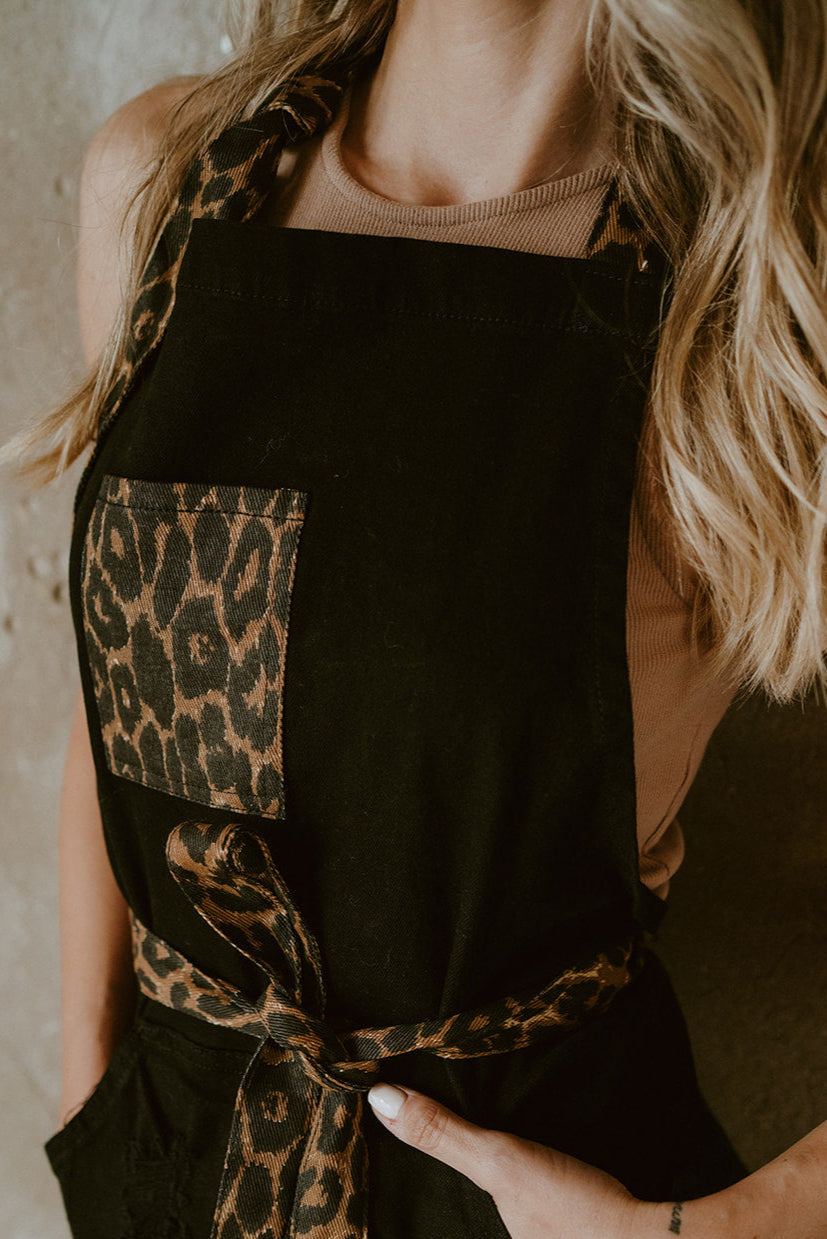
 Look at the stitching in that pocket detail. Double-reinforced stress points. Bar tacks at every corner. That construction survives years of loading shears, razors, combs, and brushes in and out hundreds of times per week.
Compare that to the single-line stitching on discount aprons that pops open the first time you bend over to pick up clippers.
## Ergonomics: The Difference Between Comfort and Chronic Pain
Here's what cheap apron manufacturers don't tell you: neck straps create a leverage problem. All the weight of the apron, your tools, and the fabric itself hangs from a narrow band around your cervical spine. Over an 8-hour shift, that's not just uncomfortable—it's a repetitive stress injury waiting to happen.
Physical therapists see this constantly in salon professionals: forward head posture, upper trapezius strain, cervicogenic headaches. All from tools and aprons that force your body into compensatory positions.
Cross-back apron designs distribute weight across your shoulders and upper back—the muscle groups actually built to handle sustained load. J. Clark Designed aprons use adjustable cross-back straps with wide surface area contact. The geometry means the weight sits on your skeletal structure, not hanging from soft tissue.
Barbers and stylists report the difference is immediate. No more unconsciously hiking your shoulders up by mid-afternoon. No more taking the apron off between every other client because your neck is screaming.
That's worth money. Actual, measurable money in reduced injury risk and increased stamina through long days.
## Pockets That Actually Function Under Professional Demands
Cheap aprons treat pockets as an afterthought—flimsy rectangles stitched onto the front with no internal structure. Drop shears in there and they immediately sag, pulling the whole apron forward and down.
Professional-grade handcrafted aprons engineer pocket placement and construction around actual tool geometry. Deep pockets with reinforced openings that maintain their shape. Interior dividers that keep your shears separate from your comb, your razor separate from your brushes.
Look at the stitching in that pocket detail. Double-reinforced stress points. Bar tacks at every corner. That construction survives years of loading shears, razors, combs, and brushes in and out hundreds of times per week.
Compare that to the single-line stitching on discount aprons that pops open the first time you bend over to pick up clippers.
## Ergonomics: The Difference Between Comfort and Chronic Pain
Here's what cheap apron manufacturers don't tell you: neck straps create a leverage problem. All the weight of the apron, your tools, and the fabric itself hangs from a narrow band around your cervical spine. Over an 8-hour shift, that's not just uncomfortable—it's a repetitive stress injury waiting to happen.
Physical therapists see this constantly in salon professionals: forward head posture, upper trapezius strain, cervicogenic headaches. All from tools and aprons that force your body into compensatory positions.
Cross-back apron designs distribute weight across your shoulders and upper back—the muscle groups actually built to handle sustained load. J. Clark Designed aprons use adjustable cross-back straps with wide surface area contact. The geometry means the weight sits on your skeletal structure, not hanging from soft tissue.
Barbers and stylists report the difference is immediate. No more unconsciously hiking your shoulders up by mid-afternoon. No more taking the apron off between every other client because your neck is screaming.
That's worth money. Actual, measurable money in reduced injury risk and increased stamina through long days.
## Pockets That Actually Function Under Professional Demands
Cheap aprons treat pockets as an afterthought—flimsy rectangles stitched onto the front with no internal structure. Drop shears in there and they immediately sag, pulling the whole apron forward and down.
Professional-grade handcrafted aprons engineer pocket placement and construction around actual tool geometry. Deep pockets with reinforced openings that maintain their shape. Interior dividers that keep your shears separate from your comb, your razor separate from your brushes.
 The Leopard Two Tone shows this perfectly—notice how the pocket structure maintains clean lines even when empty. That's internal interfacing and proper pattern work. Your tools stay where you put them, accessible instantly without fishing around.
When you're working on a client, having your shears exactly where your hand expects them saves literal seconds per movement. Multiply that across dozens of cuts per day, thousands per year. The efficiency gain alone pays for the apron.
## The Real Per-Wear Economics
Let's calculate actual cost with conservative numbers:
**Cheap apron scenario:**
- $25 per apron
- Lasts 6 months of daily professional use
- Need 6 aprons over 3 years = $150
- Cost per wear (assuming 250 work days/year): $0.20
**Handcrafted apron scenario:**
- $98 for quality handcrafted apron (like J. Clark's Black & Leather)
- Lasts 3-5 years of daily professional use
- Cost per wear over 3 years: $0.13
- Cost per wear over 5 years: $0.08
That's before factoring in the ergonomic benefits (reduced injury risk), professional appearance (client perception), and improved efficiency (functional pockets and weight distribution letting you work faster with less fatigue).
The handcrafted option is literally cheaper *and* objectively better in every measurable way.
## Sustainability and Professional Image
Mass-produced aprons end up in landfills within a year. The synthetic fabrics don't biodegrade. The entire production chain optimizes for maximum units at minimum cost, which means environmental corners get cut.
Handcrafted aprons made from organic cotton and genuine leather are fundamentally different products. They're designed to last, which means fewer resources consumed over time. When they do eventually wear out, the natural materials break down.
The Leopard Two Tone shows this perfectly—notice how the pocket structure maintains clean lines even when empty. That's internal interfacing and proper pattern work. Your tools stay where you put them, accessible instantly without fishing around.
When you're working on a client, having your shears exactly where your hand expects them saves literal seconds per movement. Multiply that across dozens of cuts per day, thousands per year. The efficiency gain alone pays for the apron.
## The Real Per-Wear Economics
Let's calculate actual cost with conservative numbers:
**Cheap apron scenario:**
- $25 per apron
- Lasts 6 months of daily professional use
- Need 6 aprons over 3 years = $150
- Cost per wear (assuming 250 work days/year): $0.20
**Handcrafted apron scenario:**
- $98 for quality handcrafted apron (like J. Clark's Black & Leather)
- Lasts 3-5 years of daily professional use
- Cost per wear over 3 years: $0.13
- Cost per wear over 5 years: $0.08
That's before factoring in the ergonomic benefits (reduced injury risk), professional appearance (client perception), and improved efficiency (functional pockets and weight distribution letting you work faster with less fatigue).
The handcrafted option is literally cheaper *and* objectively better in every measurable way.
## Sustainability and Professional Image
Mass-produced aprons end up in landfills within a year. The synthetic fabrics don't biodegrade. The entire production chain optimizes for maximum units at minimum cost, which means environmental corners get cut.
Handcrafted aprons made from organic cotton and genuine leather are fundamentally different products. They're designed to last, which means fewer resources consumed over time. When they do eventually wear out, the natural materials break down.
 But there's also the client-facing reality: what you wear signals your level of professionalism. A stylist wearing a crisp, well-fitted handcrafted apron reads differently than someone in a faded, stretched-out discount apron with fraying pockets.
Clients notice. Maybe not consciously, but the overall impression matters. You're asking them to trust you with their appearance—your own presentation is part of that trust equation.
## What to Look for in a Quality Handcrafted Apron
Not all "handcrafted" aprons deliver equal value. Here's what actually matters:
**Material weight and composition:** Look for 8-10oz cotton or denim. Anything lighter won't hold up. Organic cotton costs more but tolerates repeated washing better than conventional cotton.
**Hardware quality:** Brass or stainless steel only. Plated hardware looks fine initially but wears through to base metal within months once exposed to salon chemicals.
**Strap design:** Adjustable cross-back or H-back straps. Fixed-length straps can't accommodate different body types or adjust for wearing over different clothing thicknesses.
**Pocket reinforcement:** Interior and exterior stress points should have bar tacks or double stitching. Pockets should have some internal structure (interfacing) to prevent sagging.
**Made where:** USA-made typically means higher labor standards and quality control. J. Clark Designed manufactures in the USA specifically to maintain quality oversight through every step.
**Return policy and warranty:** Companies confident in their durability offer real guarantees. Look for at least 30-day returns and some form of construction warranty.
## When Cheap Makes Sense (Rarely)
There are exactly two scenarios where cheap aprons might be appropriate:
1. **Students in training:** If you're in beauty school and not working professionally yet, a budget apron gets you through the program. But plan to upgrade immediately when you start working—your body will thank you.
2. **Specialty one-off situations:** Need an apron for a single festival booth or one-time event? Sure, grab whatever works.
For daily professional use? Cheap aprons are always false economy.
## The Bottom Line
Handcrafted aprons cost more upfront and save you money over time while protecting your body and projecting professionalism. The cost-per-wear math definitively favors quality construction, and that's before considering the ergonomic and efficiency benefits.
For salon professionals, barbers, tattoo artists, and other creatives who wear aprons 40+ hours per week, the investment pays for itself within the first year through durability alone. The reduction in neck and shoulder strain is just bonus value.
Over 10,000 professionals in salons and barbershops have made the switch to J. Clark Designed aprons specifically because the value proposition is obvious once you've worked in both cheap and quality gear. The 4.8/5 star average across 1,444+ verified reviews backs that up—these aren't influencer testimonials, they're working professionals reporting real experience.
Buy once, buy right, and get back to focusing on your craft instead of your gear.
## FAQ
**How long should a quality handcrafted apron last with daily professional use?**
Quality handcrafted aprons last 3-5 years with daily professional use in busy salons and barbershops. Denim styles actually improve over time as the fabric softens and conforms to your body, while leather accents develop character. Compare that to 3-6 months for mass-produced alternatives before they stretch out, fade, or fall apart.
**Can handcrafted aprons handle professional salon chemicals and frequent washing?**
Yes, when properly constructed from the right materials. Organic cotton denim and genuine leather both tolerate salon chemicals far better than synthetic fabrics. J. Clark aprons use brass hardware specifically because it won't corrode when exposed to bleach, color, or sanitizers. The denim styles are machine washable, and leather accents wipe clean—they're built for real working conditions, not just looking good on a hanger.
**What's the actual price difference between cheap and quality aprons over a year?**
A $25 cheap apron replaced three times per year costs $75 annually and gives you progressively worse performance as each one degrades. A $98 handcrafted apron costs $98 once and performs consistently for 3-5 years ($19.60-$32.67 per year). The quality option is literally cheaper while delivering superior comfort, durability, and professional appearance.
**Do cross-back straps really make that much difference for neck and shoulder pain?**
Absolutely. Neck straps concentrate weight on your cervical spine and create forward head posture over long shifts. Cross-back designs distribute weight across your shoulders and upper back—the muscle groups built to handle sustained load. Physical therapists consistently recommend cross-back aprons for professionals who wear them all day. The difference is measurable and immediate.
---
Explore the full collection at [J. Clark Designed](https://www.jclarkdesigned.com/collections/all)
But there's also the client-facing reality: what you wear signals your level of professionalism. A stylist wearing a crisp, well-fitted handcrafted apron reads differently than someone in a faded, stretched-out discount apron with fraying pockets.
Clients notice. Maybe not consciously, but the overall impression matters. You're asking them to trust you with their appearance—your own presentation is part of that trust equation.
## What to Look for in a Quality Handcrafted Apron
Not all "handcrafted" aprons deliver equal value. Here's what actually matters:
**Material weight and composition:** Look for 8-10oz cotton or denim. Anything lighter won't hold up. Organic cotton costs more but tolerates repeated washing better than conventional cotton.
**Hardware quality:** Brass or stainless steel only. Plated hardware looks fine initially but wears through to base metal within months once exposed to salon chemicals.
**Strap design:** Adjustable cross-back or H-back straps. Fixed-length straps can't accommodate different body types or adjust for wearing over different clothing thicknesses.
**Pocket reinforcement:** Interior and exterior stress points should have bar tacks or double stitching. Pockets should have some internal structure (interfacing) to prevent sagging.
**Made where:** USA-made typically means higher labor standards and quality control. J. Clark Designed manufactures in the USA specifically to maintain quality oversight through every step.
**Return policy and warranty:** Companies confident in their durability offer real guarantees. Look for at least 30-day returns and some form of construction warranty.
## When Cheap Makes Sense (Rarely)
There are exactly two scenarios where cheap aprons might be appropriate:
1. **Students in training:** If you're in beauty school and not working professionally yet, a budget apron gets you through the program. But plan to upgrade immediately when you start working—your body will thank you.
2. **Specialty one-off situations:** Need an apron for a single festival booth or one-time event? Sure, grab whatever works.
For daily professional use? Cheap aprons are always false economy.
## The Bottom Line
Handcrafted aprons cost more upfront and save you money over time while protecting your body and projecting professionalism. The cost-per-wear math definitively favors quality construction, and that's before considering the ergonomic and efficiency benefits.
For salon professionals, barbers, tattoo artists, and other creatives who wear aprons 40+ hours per week, the investment pays for itself within the first year through durability alone. The reduction in neck and shoulder strain is just bonus value.
Over 10,000 professionals in salons and barbershops have made the switch to J. Clark Designed aprons specifically because the value proposition is obvious once you've worked in both cheap and quality gear. The 4.8/5 star average across 1,444+ verified reviews backs that up—these aren't influencer testimonials, they're working professionals reporting real experience.
Buy once, buy right, and get back to focusing on your craft instead of your gear.
## FAQ
**How long should a quality handcrafted apron last with daily professional use?**
Quality handcrafted aprons last 3-5 years with daily professional use in busy salons and barbershops. Denim styles actually improve over time as the fabric softens and conforms to your body, while leather accents develop character. Compare that to 3-6 months for mass-produced alternatives before they stretch out, fade, or fall apart.
**Can handcrafted aprons handle professional salon chemicals and frequent washing?**
Yes, when properly constructed from the right materials. Organic cotton denim and genuine leather both tolerate salon chemicals far better than synthetic fabrics. J. Clark aprons use brass hardware specifically because it won't corrode when exposed to bleach, color, or sanitizers. The denim styles are machine washable, and leather accents wipe clean—they're built for real working conditions, not just looking good on a hanger.
**What's the actual price difference between cheap and quality aprons over a year?**
A $25 cheap apron replaced three times per year costs $75 annually and gives you progressively worse performance as each one degrades. A $98 handcrafted apron costs $98 once and performs consistently for 3-5 years ($19.60-$32.67 per year). The quality option is literally cheaper while delivering superior comfort, durability, and professional appearance.
**Do cross-back straps really make that much difference for neck and shoulder pain?**
Absolutely. Neck straps concentrate weight on your cervical spine and create forward head posture over long shifts. Cross-back designs distribute weight across your shoulders and upper back—the muscle groups built to handle sustained load. Physical therapists consistently recommend cross-back aprons for professionals who wear them all day. The difference is measurable and immediate.
---
Explore the full collection at [J. Clark Designed](https://www.jclarkdesigned.com/collections/all)
Look at the stitching in that pocket detail. Double-reinforced stress points. Bar tacks at every corner. That construction survives years of loading shears, razors, combs, and brushes in and out hundreds of times per week.
Compare that to the single-line stitching on discount aprons that pops open the first time you bend over to pick up clippers.
## Ergonomics: The Difference Between Comfort and Chronic Pain
Here's what cheap apron manufacturers don't tell you: neck straps create a leverage problem. All the weight of the apron, your tools, and the fabric itself hangs from a narrow band around your cervical spine. Over an 8-hour shift, that's not just uncomfortable—it's a repetitive stress injury waiting to happen.
Physical therapists see this constantly in salon professionals: forward head posture, upper trapezius strain, cervicogenic headaches. All from tools and aprons that force your body into compensatory positions.
Cross-back apron designs distribute weight across your shoulders and upper back—the muscle groups actually built to handle sustained load. J. Clark Designed aprons use adjustable cross-back straps with wide surface area contact. The geometry means the weight sits on your skeletal structure, not hanging from soft tissue.
Barbers and stylists report the difference is immediate. No more unconsciously hiking your shoulders up by mid-afternoon. No more taking the apron off between every other client because your neck is screaming.
That's worth money. Actual, measurable money in reduced injury risk and increased stamina through long days.
## Pockets That Actually Function Under Professional Demands
Cheap aprons treat pockets as an afterthought—flimsy rectangles stitched onto the front with no internal structure. Drop shears in there and they immediately sag, pulling the whole apron forward and down.
Professional-grade handcrafted aprons engineer pocket placement and construction around actual tool geometry. Deep pockets with reinforced openings that maintain their shape. Interior dividers that keep your shears separate from your comb, your razor separate from your brushes.
The Leopard Two Tone shows this perfectly—notice how the pocket structure maintains clean lines even when empty. That's internal interfacing and proper pattern work. Your tools stay where you put them, accessible instantly without fishing around.
When you're working on a client, having your shears exactly where your hand expects them saves literal seconds per movement. Multiply that across dozens of cuts per day, thousands per year. The efficiency gain alone pays for the apron.
## The Real Per-Wear Economics
Let's calculate actual cost with conservative numbers:
**Cheap apron scenario:**
- $25 per apron
- Lasts 6 months of daily professional use
- Need 6 aprons over 3 years = $150
- Cost per wear (assuming 250 work days/year): $0.20
**Handcrafted apron scenario:**
- $98 for quality handcrafted apron (like J. Clark's Black & Leather)
- Lasts 3-5 years of daily professional use
- Cost per wear over 3 years: $0.13
- Cost per wear over 5 years: $0.08
That's before factoring in the ergonomic benefits (reduced injury risk), professional appearance (client perception), and improved efficiency (functional pockets and weight distribution letting you work faster with less fatigue).
The handcrafted option is literally cheaper *and* objectively better in every measurable way.
## Sustainability and Professional Image
Mass-produced aprons end up in landfills within a year. The synthetic fabrics don't biodegrade. The entire production chain optimizes for maximum units at minimum cost, which means environmental corners get cut.
Handcrafted aprons made from organic cotton and genuine leather are fundamentally different products. They're designed to last, which means fewer resources consumed over time. When they do eventually wear out, the natural materials break down.
But there's also the client-facing reality: what you wear signals your level of professionalism. A stylist wearing a crisp, well-fitted handcrafted apron reads differently than someone in a faded, stretched-out discount apron with fraying pockets.
Clients notice. Maybe not consciously, but the overall impression matters. You're asking them to trust you with their appearance—your own presentation is part of that trust equation.
## What to Look for in a Quality Handcrafted Apron
Not all "handcrafted" aprons deliver equal value. Here's what actually matters:
**Material weight and composition:** Look for 8-10oz cotton or denim. Anything lighter won't hold up. Organic cotton costs more but tolerates repeated washing better than conventional cotton.
**Hardware quality:** Brass or stainless steel only. Plated hardware looks fine initially but wears through to base metal within months once exposed to salon chemicals.
**Strap design:** Adjustable cross-back or H-back straps. Fixed-length straps can't accommodate different body types or adjust for wearing over different clothing thicknesses.
**Pocket reinforcement:** Interior and exterior stress points should have bar tacks or double stitching. Pockets should have some internal structure (interfacing) to prevent sagging.
**Made where:** USA-made typically means higher labor standards and quality control. J. Clark Designed manufactures in the USA specifically to maintain quality oversight through every step.
**Return policy and warranty:** Companies confident in their durability offer real guarantees. Look for at least 30-day returns and some form of construction warranty.
## When Cheap Makes Sense (Rarely)
There are exactly two scenarios where cheap aprons might be appropriate:
1. **Students in training:** If you're in beauty school and not working professionally yet, a budget apron gets you through the program. But plan to upgrade immediately when you start working—your body will thank you.
2. **Specialty one-off situations:** Need an apron for a single festival booth or one-time event? Sure, grab whatever works.
For daily professional use? Cheap aprons are always false economy.
## The Bottom Line
Handcrafted aprons cost more upfront and save you money over time while protecting your body and projecting professionalism. The cost-per-wear math definitively favors quality construction, and that's before considering the ergonomic and efficiency benefits.
For salon professionals, barbers, tattoo artists, and other creatives who wear aprons 40+ hours per week, the investment pays for itself within the first year through durability alone. The reduction in neck and shoulder strain is just bonus value.
Over 10,000 professionals in salons and barbershops have made the switch to J. Clark Designed aprons specifically because the value proposition is obvious once you've worked in both cheap and quality gear. The 4.8/5 star average across 1,444+ verified reviews backs that up—these aren't influencer testimonials, they're working professionals reporting real experience.
Buy once, buy right, and get back to focusing on your craft instead of your gear.
## FAQ
**How long should a quality handcrafted apron last with daily professional use?**
Quality handcrafted aprons last 3-5 years with daily professional use in busy salons and barbershops. Denim styles actually improve over time as the fabric softens and conforms to your body, while leather accents develop character. Compare that to 3-6 months for mass-produced alternatives before they stretch out, fade, or fall apart.
**Can handcrafted aprons handle professional salon chemicals and frequent washing?**
Yes, when properly constructed from the right materials. Organic cotton denim and genuine leather both tolerate salon chemicals far better than synthetic fabrics. J. Clark aprons use brass hardware specifically because it won't corrode when exposed to bleach, color, or sanitizers. The denim styles are machine washable, and leather accents wipe clean—they're built for real working conditions, not just looking good on a hanger.
**What's the actual price difference between cheap and quality aprons over a year?**
A $25 cheap apron replaced three times per year costs $75 annually and gives you progressively worse performance as each one degrades. A $98 handcrafted apron costs $98 once and performs consistently for 3-5 years ($19.60-$32.67 per year). The quality option is literally cheaper while delivering superior comfort, durability, and professional appearance.
**Do cross-back straps really make that much difference for neck and shoulder pain?**
Absolutely. Neck straps concentrate weight on your cervical spine and create forward head posture over long shifts. Cross-back designs distribute weight across your shoulders and upper back—the muscle groups built to handle sustained load. Physical therapists consistently recommend cross-back aprons for professionals who wear them all day. The difference is measurable and immediate.
---
Explore the full collection at [J. Clark Designed](https://www.jclarkdesigned.com/collections/all)

Leave a comment
This site is protected by hCaptcha and the hCaptcha Privacy Policy and Terms of Service apply.