
Article: Can a professional apron help prevent carpal tunnel and wrist strain from repetitive cutting?

Can a professional apron help prevent carpal tunnel and wrist strain from repetitive cutting?
Quick Answer: An apron alone won't prevent carpal tunnel in hairstylists, but the right design can reduce contributing factors—specifically, neck and shoulder tension caused by poorly distributed weight. When your trapezius, levator scapulae, and upper back muscles are constantly strained from a neck-loop apron, that tension travels down into your forearms and exacerbates the repetitive wrist strain that triggers carpal tunnel symptoms. Cross-back aprons redistribute weight across the shoulders and upper back, relieving the postural compensation that turns 50 haircuts a week into chronic wrist pain.
Why hairstylists develop carpal tunnel faster than most professions
Carpal tunnel syndrome shows up when the median nerve running through your wrist gets compressed—usually from repetitive flexion, extension, and grip force. Hairstylists, barbers, and colorists perform thousands of precision cuts, blow-dry angles, and clipper passes every week, each one demanding fine motor control in awkward wrist positions.
But the real accelerant isn't just the scissors. It's the cumulative postural load. When your neck and shoulders are locked in tension for 8–12 hours a day—often from a poorly designed apron strangling your cervical spine—you compensate by gripping tools harder, holding your wrists at sharper angles, and recruiting smaller forearm muscles to stabilize movements your fatigued upper back can't support. That's when inflammation creeps into the carpal tunnel.
Three factors multiply the risk:
- Static neck flexion: Leaning forward over clients while a neck-loop apron pulls your head down creates a cascade of tension through the trapezius, into the forearms, and into the flexor tendons that share the carpal tunnel with the median nerve.
- Elevated arm positions: Blow-drying, clipper-over-comb work, and foilage all require sustained shoulder elevation. If your apron adds 2–3 pounds of neck strain on top of that, your rotator cuff fatigues faster, forcing your wrists to overcompensate.
- Grip strength demand: Wet hair, thick shears, and all-day tool use require constant grip. Fatigued shoulders = weaker proximal stability = tighter distal grip = more carpal tunnel compression.
Can an apron prevent carpal tunnel in hairstylists? The cross-back advantage
An apron doesn't fix your wrist mechanics, but it can eliminate one major upstream stressor: neck and shoulder strain. Traditional neck-loop aprons hang 2–4 pounds of denim, leather, tools, phone, and product directly from your cervical spine. Over a 40-hour week, that's thousands of micro-pulls on the same muscle groups that stabilize your arms during cutting.

Cross-back straps distribute that weight across the shoulders and upper back—the muscles built to carry load—instead of the neck. The result: your trapezius and levator scapulae stay looser, your shoulder girdle maintains better posture, and your forearms don't have to compensate for upper-body fatigue. You're not curing carpal tunnel, but you're removing one chronic irritant in the kinetic chain.
J. Clark Designed aprons use adjustable cross-back straps that fit men and women across all body types. The load sits where it should: across the scapulae and mid-back, not strangling the base of your skull. Stylists who switch report less end-of-day neck tension—and often notice their wrists and hands feel less "worked" after long shifts.
Material choices that reduce mid-shift adjustments and grip fatigue
Every time you stop to wipe color off your apron, dig for shears in a shallow pocket, or retie a slipping waist strap, you're breaking your workflow and resetting your wrist position. Multiply that by 20 clients a day, and you've added hundreds of unnecessary grip cycles and postural resets—fuel for repetitive strain.
The two materials J. Clark uses are designed to stay out of your way:
- 100% organic cotton stretch denim: Stain-resistant, machine washable, breathes during back-to-back blowouts, and softens with age. The stretch moves with you during reaching and bending, so you're not fighting a stiff apron while holding scissors at odd angles.
- 100% bleach-proof vegan leather: Bleach, toner, and color literally wipe off with a damp towel—no staining, no mid-shift costume change. If you're a colorist doing 6–10 services a day, eliminating the stop-and-clean routine keeps your hands on the tools, not the apron.
Deep, reinforced front pockets hold shears, combs, clips, a phone, and color brushes without sagging or needing constant readjustment. When your tools stay put, you're not reaching, twisting, or gripping awkwardly to fish them out—small ergonomic wins that add up over thousands of repetitions.
How posture and apron design intersect with wrist health
Carpal tunnel is a distal symptom of a proximal problem. Translation: what happens at your wrist is often controlled by what's happening at your neck, shoulders, and thoracic spine. Hairstylists work in sustained forward head posture, rounded shoulders, and elevated arms—textbook setup for upper-crossed syndrome, which directly impacts forearm mechanics.

When a neck-loop apron adds traction to that forward head position, your sternocleidomastoid and upper traps lock up. Your scapulae wing out, your rotator cuff loses centration, and your forearm flexors have to work overtime to stabilize the fine motor control required for precision cutting. That overuse inflames the flexor retinaculum—the tissue that forms the "roof" of the carpal tunnel—and the median nerve gets squeezed.
Switching to a cross-back salon apron doesn't reverse carpal tunnel, but it removes one chronic postural insult. Your shoulders sit back, your neck stays neutral, and your kinetic chain works the way it's supposed to. Over weeks and months, that can mean the difference between manageable wrist soreness and chronic nerve symptoms that force you out of the chair.
Apron weight distribution vs. other ergonomic strategies
No single intervention prevents carpal tunnel in hairstylists. You need a layered approach—and apron design is one piece of the puzzle. Here's how it stacks up against other common strategies:
| Strategy | Impact on Carpal Tunnel Risk | Ease of Implementation |
|---|---|---|
| Cross-back apron | Reduces neck/shoulder tension that cascades into wrist compensation | Immediate—just change your apron |
| Ergonomic shears | Directly lowers thumb abduction force and grip demand | Moderate—requires investment and technique adjustment |
| Frequent micro-breaks | Interrupts repetitive strain cycle, reduces cumulative inflammation | Hard—requires discipline and scheduling flexibility |
| Wrist stretches/strengthening | Improves tissue resilience, but doesn't address postural load | Moderate—needs consistent daily practice |
| Adjustable chair height | Reduces overhead reaching and shoulder elevation | Easy—most salons already have hydraulic chairs |
The cross-back apron is the lowest-friction change with measurable upstream impact. You put it on once and forget it—no behavioral change required, no learning curve, just better weight distribution for the next 10,000 cuts.
Recommended aprons for hairstylists concerned about wrist and hand strain
If you're logging 30+ hours a week behind the chair and already noticing tingling, numbness, or end-of-day wrist soreness, these styles prioritize the ergonomic features that matter most.
For colorists and high-stain environments: Full Black Leather
The Full Black Leather apron is 100% bleach-proof—toner, bleach, and vivid color wipe off in seconds. No mid-shift cleaning breaks, no stopping to scrub denim. Cross-back straps keep the weight off your neck, and the vegan leather is soft enough for all-day wear but structured enough to hold tools without sagging. If you're doing back-to-back balayage or vivid color corrections, this eliminates the grip-and-twist motion of constantly repositioning a stained apron.
For barbers and high-volume cutting: Navy Pinstripe or Black Acid Washed Denim
Both the Navy Pinstripe and Black Acid Washed Denim use 100% organic cotton stretch denim that breathes during clipper work and moves with you during scissor-over-comb fades. The stretch fabric reduces the need to adjust your stance or grip when reaching across a client's head. Deep front pockets hold clippers, guards, combs, and a phone without pulling the apron forward and straining your lower back (which, yes, also affects how you stabilize your wrists).

For stylists who want versatility and style: The Bohemian or Terracotta
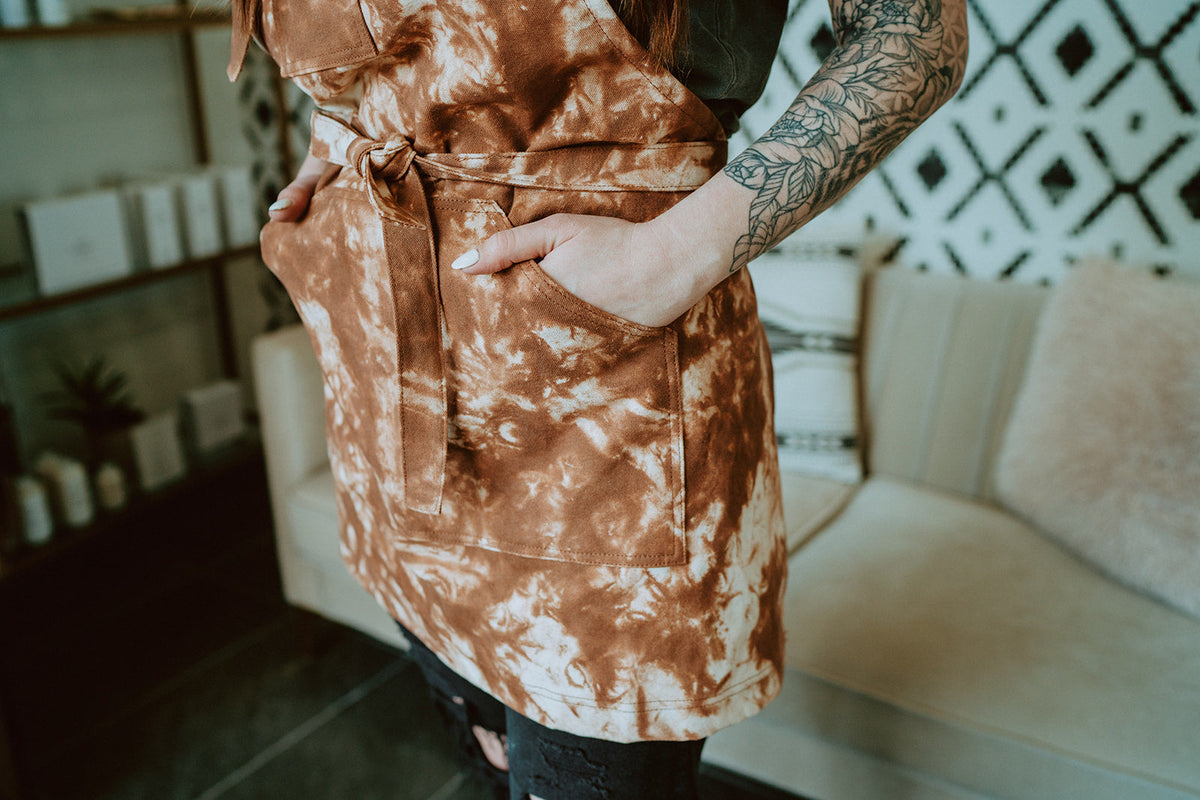
If you're bouncing between cuts, color, and styling, the Bohemian paisley or Terracotta denim offer the same cross-back ergonomics in patterns that elevate your studio aesthetic. One size fits all—adjustable straps and tie waist work across all body types, making these ideal if you're outfitting a team and want consistent ergonomic benefits without custom sizing.
The Bottom Line
Can an apron prevent carpal tunnel in hairstylists? Not on its own—but the right apron removes a major contributor to the postural dysfunction that accelerates wrist strain. Cross-back straps take chronic tension off your neck and shoulders, which keeps your kinetic chain aligned and reduces the compensatory grip and wrist angles that inflame the carpal tunnel. Combine that with stain-resistant or bleach-proof materials that eliminate mid-shift adjustments, and you've cut hundreds of unnecessary hand movements out of your week.
Carpal tunnel prevention is a multi-front effort: ergonomic shears, proper chair height, wrist strengthening, micro-breaks, and yes, an apron that distributes weight where your body is built to carry it. J. Clark Designed aprons—trusted by over 10,000 salons and barbershops, with a 4.8/5-star rating from 1,444+ verified reviews—are designed specifically for the postural and material demands of salon professionals.
If your current apron leaves you with a sore neck by noon and achy wrists by closing, the fix is simpler than you think. Switching to cross-back support won't cure existing nerve damage, but it can stop you from digging the hole deeper every single shift.
FAQ
What are the early signs of carpal tunnel syndrome in hairstylists?
Tingling or numbness in the thumb, index, and middle fingers—especially at night or first thing in the morning—are the earliest red flags. You might also notice weakness when gripping shears, difficulty holding a blow dryer for extended periods, or a tendency to drop tools. If you're shaking out your hands between clients or waking up with numb fingers, don't wait—see a hand specialist and evaluate your ergonomics immediately.
Do barbers and colorists have higher carpal tunnel risk than general hairstylists?
Yes. Barbers using clippers for hours generate sustained vibration exposure, which compounds median nerve irritation. Colorists spend more time in static shoulder elevation (foiling, applying vivids) and handle caustic chemicals that can inflame soft tissue. Both professions benefit significantly from cross-back aprons that reduce upper-body fatigue and materials (like bleach-proof leather) that eliminate repetitive cleaning motions.
Can I reverse carpal tunnel symptoms by switching aprons?
Switching to a cross-back apron can reduce the postural strain that worsens symptoms, but it won't reverse nerve damage or advanced carpal tunnel. If you're already experiencing numbness, weakness, or night pain, you need medical evaluation—potentially physical therapy, splinting, or in severe cases, surgery. An ergonomic apron is a preventive and supportive tool, not a cure. Pair it with other interventions: wrist stretches, proper tool mechanics, and regular breaks.
How do I know if my apron is contributing to neck and shoulder tension?
Simple test: wear your apron for a full shift, then take it off and notice if your neck and upper traps feel immediately lighter. If you're constantly adjusting the neck loop, rolling your shoulders, or massaging the base of your skull between clients, your apron is part of the problem. Cross-back designs eliminate that cervical traction entirely—you should feel stable support across your mid-back, not a noose around your neck.
Explore the full collection at J. Clark Designed.
```

Leave a comment
This site is protected by hCaptcha and the hCaptcha Privacy Policy and Terms of Service apply.