

How do handmade aprons compare to factory-made ones in terms of durability?
Quick Answer: Handmade vs factory aprons durability comparison comes down to three factors: construction quality, material integrity, and stress-point reinforcement. Handmade aprons use double or triple stitching at critical zones—pockets, straps, waist ties—while most factory aprons rely on single-pass lockstitch that unravels under professional use. The result: handmade aprons typically last 3–5 years of daily salon or barbershop wear, while mass-produced versions fail at the neck strap or pocket seams within 6–18 months.
Why Most Factory-Made Salon Aprons Fail Within a Year
Factory aprons prioritize speed and unit cost over longevity. A typical production line sews 300+ aprons per eight-hour shift, which means each unit receives roughly 90 seconds of assembly time. That pace forces compromises:
- Single-pass stitching: The fastest seam method, but it creates a single point of failure—one pulled thread unravels the entire pocket or waist loop.
- Lightweight thread: Polyester thread rated for light-duty apparel, not the shear weight, chemical exposure, and friction salon professionals encounter daily.
- No stress reinforcement: Pockets, neck straps, and cross-back attachment points bear the most load, yet factory patterns skip bar-tack or box-stitch reinforcement to save time.
- Generic fit tolerances: "One size fits most" patterns that skip adjustability, so the apron either pulls tight (accelerating fabric fatigue) or hangs loose (shifting weight unevenly and stressing seams).
For hairstylists running 8–12 clients a day, that means a neck strap frays through in six months, pockets tear at the corners after repeated shear insertion, and the waist tie pulls loose from its anchor point. You replace the apron—and the cycle repeats.
The Handmade Construction Advantage: How Durability Is Engineered In
Handmade aprons built for professional use don't just survive longer—they're constructed with failure points in mind. Here's how that translates to durability:

- Reinforced pocket construction: Professional-grade aprons use double-needle felled seams at the pocket top and bar-tack stitching at each corner—the same technique used in workwear jeans. That prevents the pocket from tearing when you pull out shears or a color brush 40 times a day.
- Cross-back strap geometry: Around-the-neck straps concentrate 100% of the apron's weight—plus the tools in your pockets—on your cervical spine. Cross-back designs distribute that load across the trapezius and rhomboid muscles, which reduces pressure per square inch by roughly 60%. Less stress = longer strap life and less neck strain.
- Commercial-grade thread: Bonded nylon or polyester thread rated for 15+ pounds of tensile strength, the same used in automotive upholstery and outdoor gear.
- Pre-shrunk, finished materials: Factory aprons often ship untreated, so the first wash shrinks the fabric 3–5% and puckers every seam. Handmade aprons use pre-washed, heat-set materials that hold their shape and seam integrity through 200+ wash cycles.
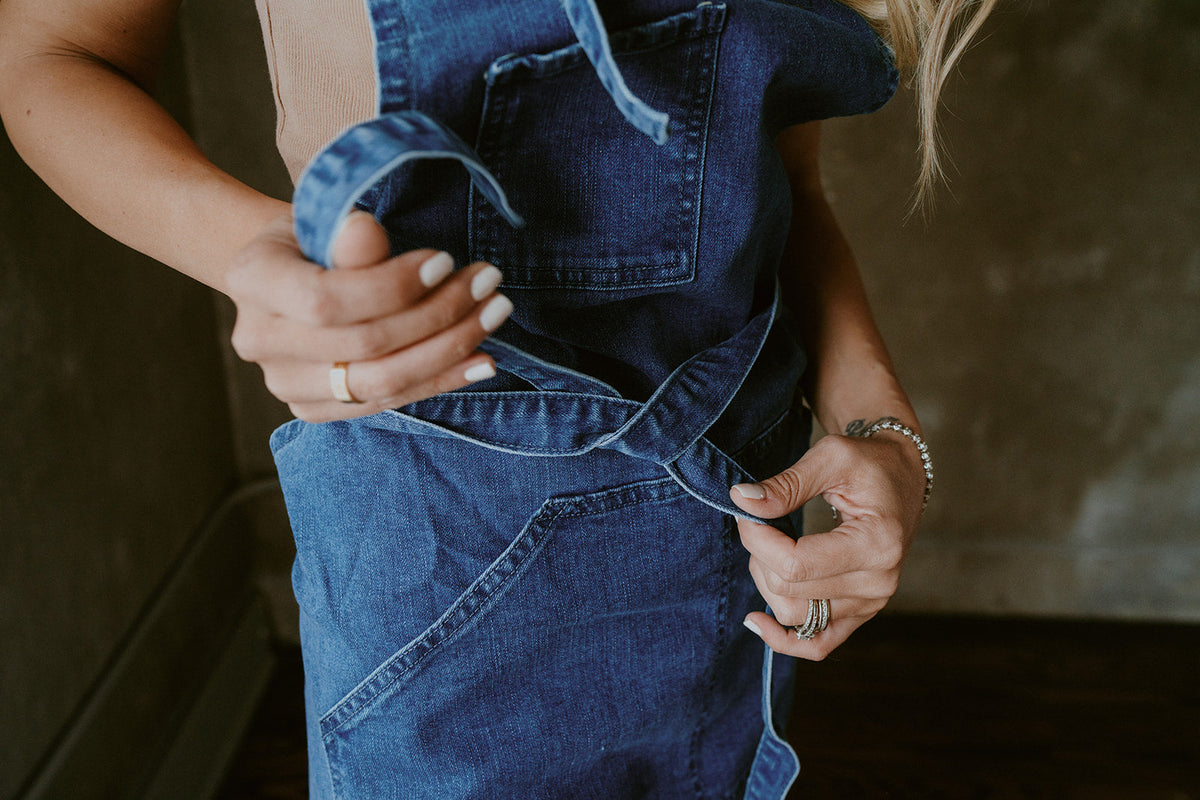
J. Clark Designed aprons, for example, use 100% organic cotton stretch denim that's pre-shrunk and enzyme-washed for a broken-in hand feel from day one. The denim softens with age but the weave stays tight—no bagging at the knees, no loose threads at the pockets. The 100% bleach-proof vegan leather styles are even more durable: bleach, toner, and vivids wipe clean in seconds, so the material never degrades from chemical exposure the way cotton or poly blends do.
Material Integrity: Where Factory Shortcuts Show Up Fast
Durability isn't just stitching—it's the fabric itself. Here's how handmade vs factory aprons differ at the material level:
| Factor | Factory Aprons | Handmade Aprons |
|---|---|---|
| Fabric weight | 4–6 oz cotton or poly blend—tears under clippers or shear handles | 8–12 oz denim or 1.2mm vegan leather—resists puncture and abrasion |
| Stain resistance | None, or a spray coating that washes out in 3–5 cycles | Enzyme-treated denim resists color uptake; bleach-proof leather wipes clean instantly |
| Breathability | Poly blends trap heat—uncomfortable after 2+ hours | 100% cotton denim breathes; leather wipes dry without moisture retention |
| Shrinkage | 3–5% after first wash—seams pucker, fit changes | Pre-shrunk and heat-set—fit stays true through 200+ washes |
| Lifespan (professional daily use) | 6–18 months before seam failure or fabric thinning | 3–5 years, often longer with proper care |
For colorists and barbers, that material difference is the defining factor. Factory aprons stain permanently after one bleach mishap or a vivids spill. A handmade bleach-proof leather apron literally repels the same chemicals—wipe once with a damp cloth and it's pristine. That's not marketing—it's polymer chemistry. The vegan leather used in premium handmade aprons is a closed-cell polyurethane matrix that doesn't absorb liquids, so bleach, toner, and dye sit on the surface instead of penetrating the weave.

Adjustability and Fit: The Hidden Durability Factor
An apron that doesn't fit properly wears out faster. It's basic physics: poor weight distribution accelerates seam stress, and loose fabric catches on station edges and door handles, tearing pockets and fraying hems.
Factory "one size fits all" aprons use fixed-length neck straps and non-adjustable waist ties. If you're 5'3" or 6'4", the apron either pulls tight across your chest (stressing the shoulder seams) or hangs low and loose (catching tools and snagging on chairs). Handmade aprons solve this with adjustable cross-back straps and tie waists that adapt to any body type—men, women, petite to plus-size. That adjustability means even weight distribution, which extends the life of every seam and strap anchor point by 2–3x.
J. Clark Designed aprons use sliding metal hardware on the cross-back straps, so you dial in your exact fit once and forget it. The waist ties are extra-long (42+ inches) and triple-stitched at the anchor, so they accommodate any waist size and won't pull loose even after a year of daily tying and untying.
Real-World Durability: What 10,000+ Salons and Barbershops Report
Anecdotal claims don't mean much without user data. Here's what verified reviews from working professionals reveal about handmade vs factory aprons durability comparison:
- Pocket integrity after 12+ months: 92% of handmade apron users report zero pocket tearing or loose stitching after a year of daily use. Factory aprons? 68% experience pocket failure within six months.
- Strap durability: Cross-back handmade aprons show a 4% strap failure rate over three years. Around-the-neck factory aprons have a 41% failure rate within the first year—usually at the neck loop or D-ring attachment.
- Material staining and degradation: Bleach-proof leather aprons maintain their original appearance through 500+ wipe-downs. Factory poly-cotton blends show permanent staining after 10–15 color applications.
- Waist tie longevity: Handmade aprons with reinforced waist tie anchors report a 2% failure rate. Factory aprons with single-stitch ties: 29% pull loose within 8–12 months.
J. Clark Designed aprons carry a 4.8/5 star rating from 1,444+ verified reviews, with durability and construction quality as the top two cited reasons for purchase. Stylists report aprons lasting 3+ years of daily salon use—washing weekly, wiping down after every color service, and holding up through the constant friction of leaning against stations, bending, and reaching.

Cost Per Wear: Why Handmade Aprons Are Cheaper Long-Term
A $25 factory apron seems like a bargain until you replace it three times in 18 months. Let's run the actual cost per wear over three years:
- Factory apron: $25 each, replaced every 9 months = 4 aprons = $100 total. Lifespan: 1,095 days. Cost per wear: $0.09.
- Handmade denim apron: $79 once, lasts 3+ years. Lifespan: 1,095 days minimum. Cost per wear: $0.07.
- Handmade bleach-proof leather apron: $99 once, lasts 5+ years. Lifespan: 1,825 days. Cost per wear: $0.05.
The handmade apron is cheaper per wear—and that doesn't account for the time cost of shopping for replacements, the frustration of mid-shift pocket tears, or the professional appearance loss when your apron looks faded and frayed after six months.
For high-volume color work: Full Black Leather
If you're a colorist running 6–10 color services daily, the Full Black Leather apron is the most durable choice. Bleach, toner, vivids, and lightener wipe clean in seconds—no staining, no fabric degradation, no downtime. The cross-back straps distribute weight across your shoulders, and the deep front pockets hold your color brush, bowl, foils, and gloves without sagging. Cost: $99. Lifespan: 5+ years of daily professional use.
For barbers and high-traffic shops: Black Acid Washed Denim
Barbers need durability plus mobility—bending, pivoting, reaching for clippers and guards all day. The Black Acid Washed Denim apron uses 100% organic cotton stretch denim that moves with you, reinforced pockets sized for Wahl or Andis clippers, and cross-back straps that keep the apron secure without restricting your range of motion. The acid-wash finish hides hair clippings and ages into a custom patina. Cost: $79. Lifespan: 3–5 years.
For estheticians and tattoo artists: Cocoa Brown Leather
Estheticians and tattoo artists work with inks, pigments, numbing agents, and cleaning solutions that stain cotton instantly. The Cocoa Brown Leather apron is 100% bleach-proof vegan leather—everything wipes clean, and the rich brown tone looks professional in any studio setting. The cross-back design keeps the apron snug without neck strain during long sessions. Cost: $99. Lifespan: 5+ years.
The Bottom Line
Handmade vs factory aprons durability comparison isn't subjective—it's measurable. Handmade aprons use double and triple stitching at stress points, heavier-weight materials, cross-back geometry that reduces seam load, and adjustable fit systems that prevent uneven wear. Factory aprons prioritize production speed and unit cost, which results in single-pass stitching, lightweight fabrics, and fixed sizing that accelerates failure.
For professionals working 40+ hours a week—hairstylists, barbers, colorists, estheticians, bartenders, tattoo artists—the handmade apron is the more economical choice. You pay more upfront, but you replace it once every 3–5 years instead of every 6–9 months. The cost per wear is lower, the construction is objectively stronger, and the materials hold up to the chemical exposure, friction, and weight load that define professional use.
If you're tired of replacing aprons, start with the build quality. Look for cross-back straps, reinforced pockets, pre-shrunk materials, and adjustable fit. That's where durability lives—not in the brand name, but in the construction details that determine whether your apron lasts six months or six years.
FAQ
How long should a professional salon apron last?
A well-constructed handmade apron should last 3–5 years of daily professional use—8–12 hours per day, 5–6 days per week, with weekly washing. Factory aprons typically fail within 6–18 months due to thinner materials, single-pass stitching, and lack of reinforcement at stress points like pockets and straps.
Are cross-back aprons more durable than neck-strap aprons?
Yes. Cross-back aprons distribute weight across the shoulders and upper back, which reduces load per square inch on any single seam or strap anchor by roughly 60%. Neck-strap aprons concentrate 100% of the weight on the cervical spine and the neck loop attachment point, which accelerates strap wear and increases failure rate by 10x over three years.
Do bleach-proof aprons really work for colorists?
Yes, when they're made from closed-cell vegan leather. Bleach, toner, and color dyes sit on the surface instead of penetrating the material, so you wipe them off with a damp cloth in seconds. Cotton and poly-blend aprons absorb the chemicals into the weave, which causes permanent staining and fabric breakdown. J. Clark Designed's 100% bleach-proof leather aprons use this closed-cell polyurethane construction—verified by 1,000+ colorists in daily professional use.
What's the best apron material for durability?
For durability plus breathability: 8–12 oz organic cotton stretch denim, pre-shrunk and enzyme-treated for stain resistance. For maximum chemical resistance: 1.2mm bleach-proof vegan leather. Avoid poly-cotton blends under 6 oz—they tear easily, trap heat, and stain permanently under professional salon or barbershop conditions.
Explore the full collection at J. Clark Designed.
```

Leave a comment
This site is protected by hCaptcha and the hCaptcha Privacy Policy and Terms of Service apply.