

How do I choose an apron that won't restrict movement when doing clipper work?
Quick Answer: An apron that doesn't restrict movement during clipper work needs cross-back straps, stretch in the fabric or give in the construction, and a cut that sits snug at the waist without bunching at the shoulders. Traditional neck-strap aprons pull forward when you lean or reach, creating drag across your chest and neck—cross-back designs distribute weight across your upper back and shoulders, keeping the apron anchored while you move freely through fades, tapers, and detail work.
Why Neck-Strap Aprons Restrict Movement During Clipper Work
Most salon and barber aprons hang from a single loop around the neck. That works fine if you're standing still, but clipper work demands constant motion—leaning in for temple fades, stepping back to check angles, rotating around the chair for edge-ups.
Every time you lean forward, the apron's weight pulls the neck strap taut, creating a choking sensation and dragging the bib downward. Your body compensates by hunching your shoulders or shortening your reach. Over an eight-hour day, that repetitive strain adds up: neck fatigue, upper-trap tension, and a subtle but chronic restriction in how freely you can move your arms.
The second issue: neck-strap aprons rotate. When you pivot or reach across the client, the apron twists around your torso, bunching fabric under your dominant arm or catching on your hip. You're constantly tugging it back into place—breaking flow, losing focus, and adding micro-interruptions to every cut.
What Makes an Apron Move With You Instead of Against You
Three features separate aprons that restrict movement from those that disappear into your workflow:
- Cross-back straps: Instead of a neck loop, the straps cross between your shoulder blades and anchor at the waist ties. This spreads the apron's weight across your upper back and shoulders—the strongest, most stable part of your posture—so there's zero pull on your neck. You can lean, reach, and rotate without resistance.
- Stretch or give in the material: Rigid canvas and heavy twill lock your torso into a stiff shell. Stretch denim (woven with a small percentage of elastic fiber) or supple vegan leather moves with your body, flexing when you bend and snapping back when you straighten. The apron becomes a second skin, not a straitjacket.
- Adjustable, tailored fit: One-size-fits-all only works if the straps and waist ties offer enough adjustment to customize the fit. A bib that sits too high rides up when you move; one that's too loose flaps and twists. Adjustable cross-back straps let you dial in the exact length so the apron sits snug at the waist and flat across the chest, eliminating slack that catches on clippers or chair arms.

Cross-Back vs. Neck-Strap: A Side-by-Side Comparison for Barbers
| Feature | Neck-Strap Apron | Cross-Back Apron |
|---|---|---|
| Weight distribution | Entire load on neck and cervical spine | Spread across shoulders and upper back |
| Forward lean (fades, detail work) | Strap tightens, pulls you back | No resistance—moves with you |
| Rotation around the chair | Apron twists, bunches under arms | Stays anchored at the waist, no twisting |
| End-of-day fatigue | Neck ache, upper-trap tension | Minimal strain—weight carried by stronger muscles |
| Adjustability | Limited—strap length fixed or minimal range | Fully adjustable straps + waist ties = custom fit |
Material Matters: Why Stretch Denim and Vegan Leather Outperform Canvas
The fabric itself is half the movement equation. Traditional canvas aprons—the kind you'll find at most uniform suppliers—are woven from 100% cotton with zero give. They're durable, sure, but they're also stiff, heavy, and unforgiving. Every time you raise your arm or twist your torso, you're fighting the apron's resistance.
Stretch denim changes the game. By blending organic cotton with a small amount of elastic fiber, the fabric gains just enough flex to move with your body without losing structure. J. Clark Designed's 100% organic cotton stretch denim is engineered for salon and barber professionals—it's breathable (critical when you're on your feet all day), machine washable, and it softens with age instead of stiffening. Stains lift easily, and the fabric doesn't trap heat against your torso the way synthetics do.
100% bleach-proof vegan leather is the other standout. Unlike traditional leather (which stains permanently) or coated polyester (which cracks and peels), bleach-proof vegan leather is chemically inert. Bleach, toner, and color literally wipe off with a damp cloth—no staining, no ghosting, no fabric memory. The material is supple enough to drape naturally but structured enough to hold deep pockets without sagging. For barbers who also do color work or share space with colorists, it's the only material that eliminates cross-contamination between clients.

How to Fit an Apron for Maximum Range of Motion
Even a well-designed apron restricts movement if it's worn incorrectly. Here's how to dial in the fit:
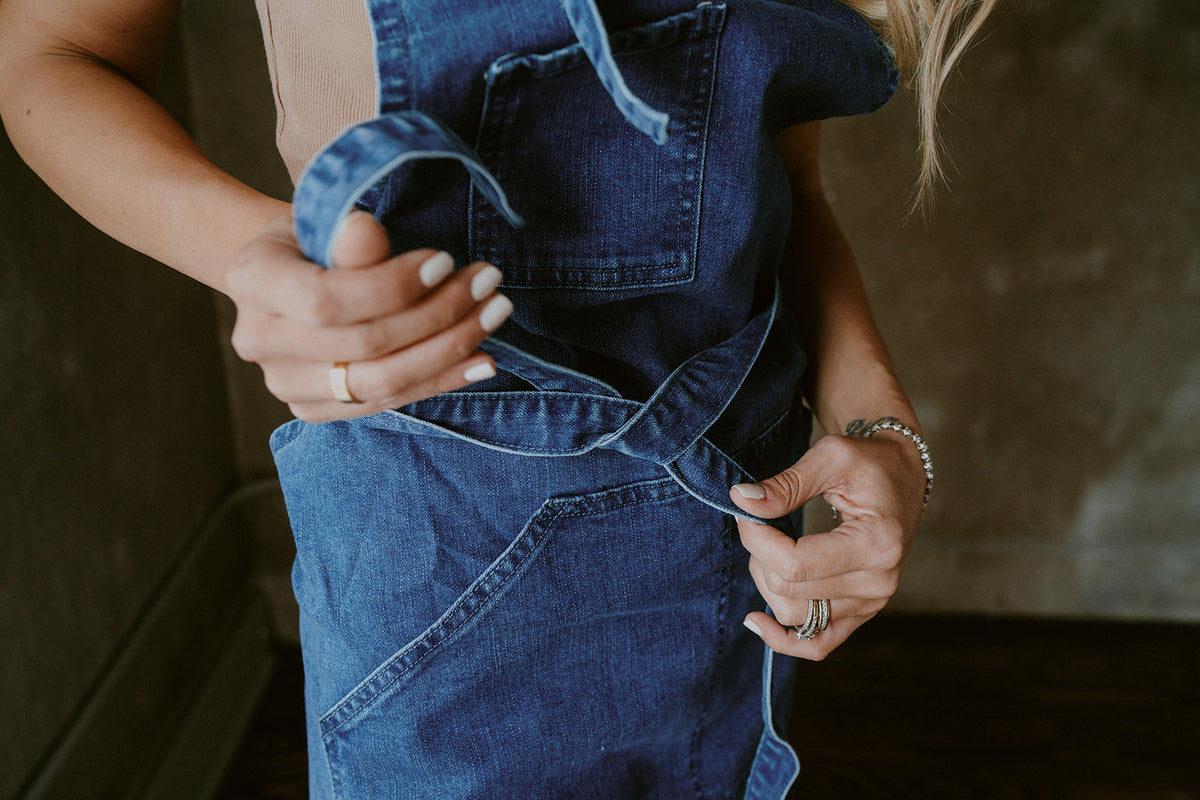
- Adjust the cross-back straps first. Put the apron on and tighten the straps until the bib sits flat against your chest—not loose enough to flap, not tight enough to constrict your breathing. The X should sit between your shoulder blades, not at your neck or mid-back.
- Tie the waist snug. The waist tie is the anchor point. Tie it firmly enough that the apron doesn't shift when you move, but not so tight it digs into your sides. Most professionals tie it just above the hip bones—low enough to avoid restricting your diaphragm, high enough to keep the bib stable.
- Check your reach. Raise both arms overhead, then lean forward as if you're doing a temple fade. The apron should move with you—no pulling at the neck, no bunching at the armpits, no fabric catching under your arms. If you feel resistance, loosen the cross-back straps slightly and retie the waist.
Once dialed in, the apron should feel like it's barely there. You shouldn't think about it mid-cut.
Pocket Placement and Depth: Why It Affects Your Posture
Deep, reinforced pockets are non-negotiable for clipper work—you need fast access to guards, combs, and edge tools without breaking rhythm. But pocket placement directly impacts how freely you move.
Pockets that sit too high (mid-chest) force you to reach up and across your body, creating shoulder fatigue and breaking your line of sight with the client. Pockets that sit too low (below the waist tie) sag when loaded with tools, pulling the apron downward and throwing off the fit.
The sweet spot: pockets that sit just below the chest, at natural hand height when your arms hang relaxed. J. Clark Designed aprons place pockets at this exact level, sized to hold clippers, shears, a phone, and a comb without sagging or restricting your range of motion. The reinforced stitching prevents pocket blowout even when you're carrying heavy guards or a loaded spray bottle.
Top Apron Picks for Barbers Who Need Unrestricted Movement
Every apron below features cross-back straps, adjustable sizing, and materials engineered for all-day wear. These are the styles trusted by barbers, hairstylists, and grooming professionals who log 40+ hours a week behind the chair.
For Traditional Barbershops: Black Acid Washed Denim
The Black Acid Washed Denim is the workhorse apron for high-volume clipper work. The organic stretch denim moves with you, the acid wash hides stray hairs and minor stains, and the cross-back straps eliminate neck strain during back-to-back fades. Machine washable, $59–$79 depending on configuration.
For Barbers Who Do Color: Full Black Leather (100% Bleach-Proof)
If you offer color services, beard toning, or gray blending, the Full Black Leather is the only apron you need. 100% bleach-proof vegan leather means bleach, toner, and dye wipe off in seconds—zero staining, zero fabric memory. Supple enough to flex with your body, structured enough to hold tools securely. $99.
For Modern Salons and Hybrid Stylists: Black & Leather (Over-Shoulder)
The Black & Leather (Over-Shoulder) combines stretch denim with bleach-proof leather panels at the chest and pockets—giving you stain protection where you need it and breathability everywhere else. Cross-back straps keep weight off your neck during marathon cutting sessions. $79.

The Bottom Line
An apron that doesn't restrict movement during clipper work starts with cross-back straps that anchor the weight across your shoulders instead of your neck. Pair that with stretch denim or supple vegan leather, and you eliminate the two biggest sources of restriction: forward pull when you lean, and fabric stiffness when you rotate.
Adjustability is the final piece—one size fits all only works if you can customize the fit to your body. Deep, well-placed pockets keep tools accessible without throwing off your posture. And materials like 100% bleach-proof vegan leather future-proof your investment, especially if you work in a hybrid barber/color environment.
J. Clark Designed aprons are engineered specifically for professionals who can't afford to compromise on movement. 4.8 stars from 1,444+ verified reviews, trusted by 10,000+ salons and barbershops, and backed by free shipping on every order.
FAQ
Do cross-back aprons work for all body types?
Yes. J. Clark Designed aprons feature fully adjustable cross-back straps and waist ties, allowing one size to fit men and women across all body types. The straps adjust from petite frames to 2XL+, and the waist tie offers enough length to customize the fit without bunching or gaping.
Can I wear a cross-back apron if I have neck or shoulder pain?
Cross-back aprons are specifically designed to relieve neck and shoulder strain. By distributing weight across your upper back and shoulders instead of hanging from your cervical spine, they eliminate the forward pull that causes chronic neck pain. Many barbers and stylists switch to cross-back designs on the recommendation of physical therapists.
What's the best apron material for high-volume clipper work?
Stretch denim is ideal for all-day clipper work—it's breathable, machine washable, and flexible enough to move with you. If you also do color, beard toning, or chemical services, 100% bleach-proof vegan leather is the smarter investment: it offers the same flexibility as denim but wipes clean in seconds, eliminating cross-contamination between clients.
How do I know if my apron is fitted correctly?
A correctly fitted apron sits flat against your chest with no slack at the neckline, and the waist tie anchors just above your hips. When you raise your arms overhead or lean forward, you should feel zero pull at the neck and no bunching under your arms. If you feel resistance, loosen the cross-back straps slightly and retie the waist.
Explore the full collection at J. Clark Designed.
```


Leave a comment
This site is protected by hCaptcha and the hCaptcha Privacy Policy and Terms of Service apply.