
Do apron pockets actually matter? What salon professionals need to carry
Quick Answer: Yes, apron pockets absolutely matter for salon professionals. The difference between a frustrating workday and an efficient one often comes down to whether your shears, combs, clips, and sectioning tools are exactly where you need them—without neck strain from tool belts or constant trips back to your station. Professional-grade apron pockets should be deep enough to secure 6.5"+ shears, positioned to avoid hip bruising, and reinforced to handle daily abuse without sagging.

The Real Cost of Bad Pockets (And It's Not Just About Dropped Shears)
Walk into any established salon and watch the professionals who've been behind the chair for 10+ years. They're not carrying tool belts. They're not wearing those nylon vests with seventeen tiny pockets. They've learned the hard way that most apron pockets are designed by people who've never actually worked a double on a Saturday.
Poor pocket design creates three specific problems:
- Repetitive strain: Shallow pockets mean you're constantly adjusting, readjusting, and picking up dropped tools. That's hundreds of extra bends and reaches per day.
- Tool damage: When shears slide horizontally in loose pockets, the tips drag against fabric and dull faster. A $400 pair of Hikari shears shouldn't be rattling around like loose change.
- Client safety: Pockets that can't secure your tools become liability issues. One dropped razor near a client's face is one too many.
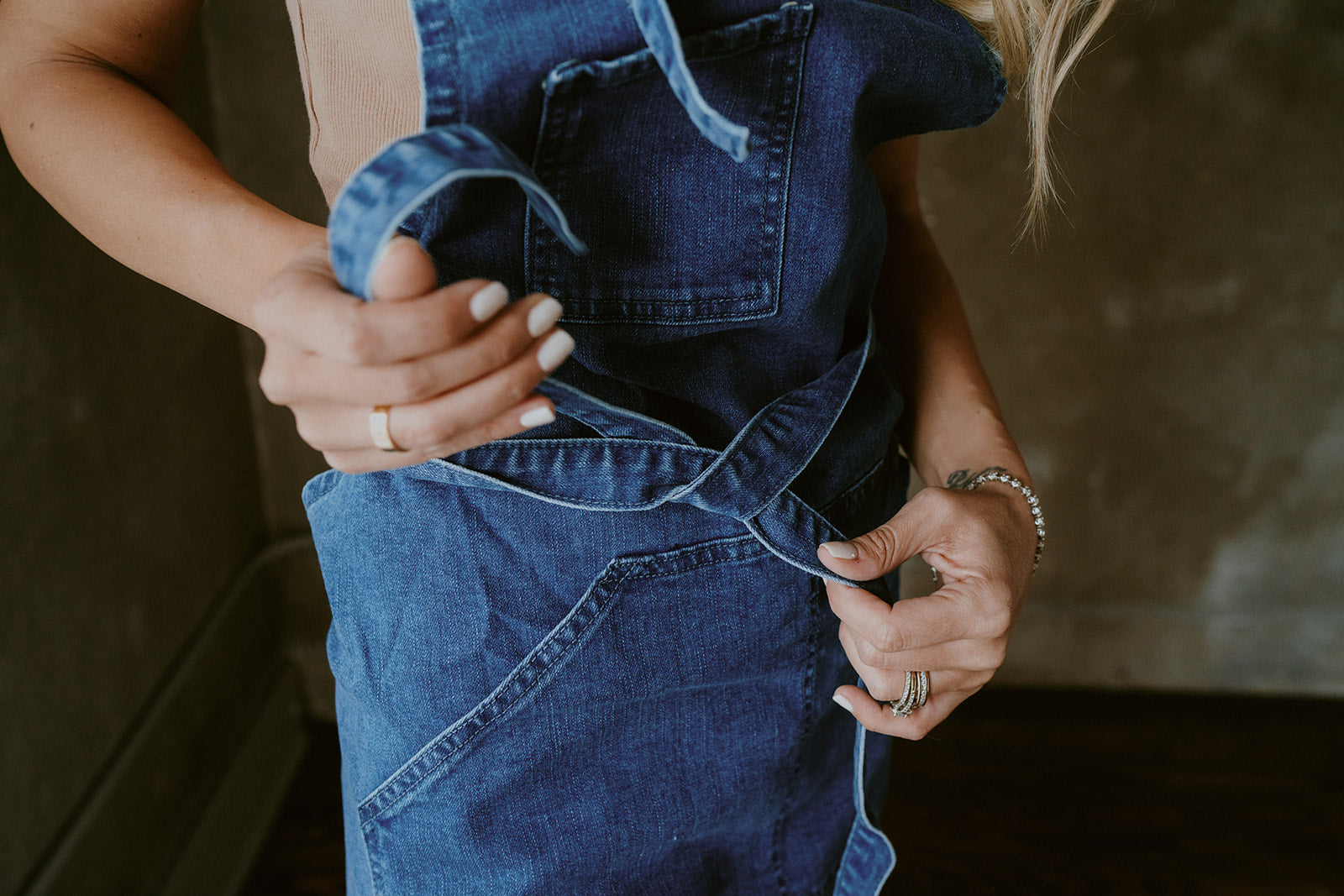
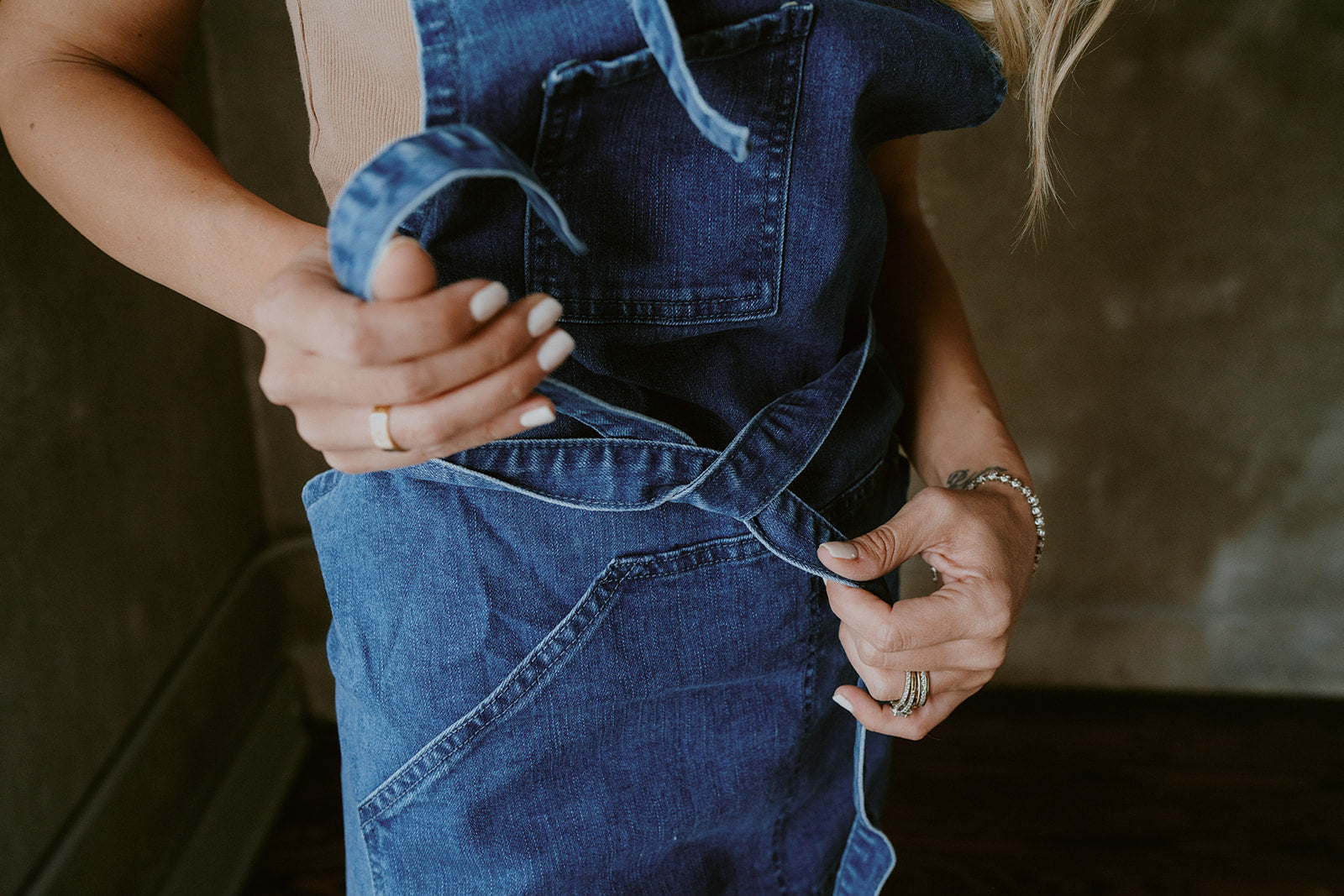
Justin Clark designed J. Clark Designed aprons after spending years watching stylists jury-rig their workwear with safety pins and added clips. The deep front pockets (7.5" on most styles) were engineered specifically for professional shears, with reinforced stitching at stress points where most aprons fail within six months.
What Actually Needs to Be in Your Pockets During a Service
Let's be specific about what working professionals carry, because this determines pocket depth, width, and placement.
The Core Kit (Always Accessible)
Cutting shears (6.5"–7"): Your primary shears need a dedicated vertical pocket that holds them tip-down, handles up. Horizontal pockets are useless here—you want one-handed grab-and-go access. The pocket depth needs to exceed your shear length by at least an inch to prevent tip-first drops.
Texturizing shears or thinners: Same requirements as cutting shears. If you regularly use both during the same service, you need two proper shear pockets, not one deep one where they tangle together.
Tail comb and cutting comb: These live in the same pocket as shears in many aprons, but better designs separate them. Combs should have their own slightly shallower pocket (5"–6") so you're not fishing past handles.
Sectioning clips (4–8 clips): Most stylists carry at least four duck bill clips or double-prong clips. These need a wide pocket with enough room that they don't spring open and catch on pocket edges when you grab one.

The Secondary Tools (Frequently Needed)
Spray bottle or leave-in product: This doesn't go in pockets—it creates uneven weight distribution and pocket sag. But your apron needs to accommodate movement without this bottle catching on pocket edges when it's tucked in your waistband or clipped to your station.
Razor and guards: If you do razor cutting or detailed barbering work, you need a separate razor pocket with a secure closure. Razors don't mix well with other tools, period. Some stylists prefer a small belt holster for this, but a dedicated apron pocket with a snap or magnetic closure works if the apron sits high enough on your torso.
Pencil or chalk for parting: Underrated but essential for precision work. A small side pocket or pen loop keeps this from getting lost in the main tool pocket.
What Doesn't Belong in Apron Pockets
Your phone. Seriously. The number of cracked screens and color-stained phones from stylists who pocket their device during color application is staggering. Same goes for car keys (scratched by shear handles) and anything you can't afford to get covered in hair clippings.
Pocket Placement: Why Hip-Level Pockets Cause Problems
Here's where most apron designers get it wrong: they place pockets at hip level because that's where pants pockets go. But pants pockets aren't holding sharp objects while you're bending, reaching, and moving around a client chair 40 times per service.
Hip-level pockets create two specific issues:
Bruising and pressure points: When pockets sit directly at hip bone level and you're carrying 8–12 ounces of steel tools, that weight presses against bone every time you lean into a client or kneel down. After eight hours, you'll have visible marks.
Tool accessibility when seated: If you do any seated work (beard trims, children's cuts, detailed color application), hip pockets become completely inaccessible. You're either standing up repeatedly or working without your tools in reach.
Better pocket placement sits slightly higher—approximately 2–3 inches below your natural waist. This distributes weight across the apron's structure rather than against your pelvis, and keeps tools accessible whether you're standing or seated on a rolling stool.
The J. Clark Designed approach uses cross-back straps that distribute the apron's weight across your shoulders rather than hanging from your neck. This allows for higher pocket placement without the apron riding up, and the adjustable straps mean you can fine-tune pocket height based on your torso length and preferred working posture.
Material Matters: Why Canvas and Denim Beat Synthetic Fabrics
Pocket durability isn't just about stitching—it's about material memory and abrasion resistance.
Synthetic fabrics (polyester blends, nylon) are popular because they're cheap and stain-resistant. But they fail in professional use because:
- They stretch out permanently under weight. After 3–6 months of carrying tools, synthetic pockets sag and lose their shape.
- Shear tips can snag and create runs in the fabric, similar to pantyhose damage.
- They don't develop a protective patina—they just look progressively more worn.
Natural fabrics like organic cotton denim and canvas maintain their structure under repeated stress. Denim especially develops a broken-in feel that actually improves with age—the fabric softens while the weave maintains integrity. This is why quality work aprons use 10–12 oz denim rather than the 5–6 oz material in fashion jeans.
J. Clark Designed aprons use organic cotton denim with double-reinforced pocket stitching at stress points. The leather accents aren't decorative—they're positioned at pocket corners where fabric-on-fabric friction causes the fastest wear. This hybrid construction means pockets that survive years of professional use rather than months.

The Multi-Pocket Trap: Why More Isn't Better
Some aprons advertise 8, 10, or 12 pockets like it's a selling point. It's not. It's a sign the designer doesn't understand professional workflow.
Here's the reality: you develop muscle memory for pocket placement. Your right hand knows exactly where your shears live. Your left hand knows exactly where clips are stored. When you multiply pockets beyond 3–4 functional spaces, you're constantly second-guessing placement and searching for tools.
Professional-grade aprons typically feature:
- Two deep vertical pockets for shears and primary tools (left and right side, or both on dominant side depending on preference)
- One wider horizontal pocket for clips, combs, and secondary tools
- Optional small utility pocket for pencil, business cards, or hair ties
That's it. Four pockets maximum. Each one serves a specific, consistent function that you can access without looking down.
The exception: specialized professionals who work across disciplines. A stylist who also does makeup or nail services might need additional compartments for brushes or files. But for pure hair work—cutting, coloring, styling—simplicity wins.
Weight Distribution: The Overlooked Factor in All-Day Wear
Empty pockets don't tell you much. Load them with your actual working tools and wear the apron for eight hours. That's the real test.
A fully loaded professional apron carries approximately:
- Shears (primary): 4–6 oz
- Shears (texturizing): 4–6 oz
- Combs (2): 1–2 oz
- Clips (6): 2–3 oz
- Razor + guards: 2–3 oz
- Total: 13–20 oz (roughly 1–1.5 pounds)
That doesn't sound like much until you're carrying it asymmetrically for a full shift. Poor weight distribution creates:
- Lower back compensation as you unconsciously shift away from the weighted side
- Shoulder strain if the apron hangs from neck ties rather than cross-back straps
- Hip soreness if pockets sit directly on bone
Cross-back strap designs solve this by distributing weight across both shoulders, similar to how a proper backpack works. The straps should be adjustable—bodies change, and what fits perfectly at the start of a shift might need adjustment after lunch when you're carrying a different tool loadout.
Testing Pocket Quality Before You Buy
If you're shopping online, you can't physically test pockets. But you can look for specific design indicators:
Pocket depth measurements: Legitimate manufacturers list actual pocket dimensions, not vague terms like "deep pockets." Look for minimum 7" depth for shear pockets, 5–6" for comb pockets.
Reinforcement details: Check product photos for bar-tack stitching (the small rectangular stitch pattern) at pocket corners and openings. This is industry-standard reinforcement for stress points.
Material weight: Apron fabric should be listed in ounces per square yard. Professional-grade denim is 10–14 oz. Anything under 8 oz will stretch out quickly.
Customer reviews from actual professionals: Discount reviews that say "cute apron!" and focus on ones that mention specific use cases: "Pockets held up through six months of daily barbering" or "Finally don't have to readjust my shears every five minutes."
J. Clark Designed aprons average 4.8 stars from over 1,400 verified reviews, with the most common praise focusing on pocket durability and tool accessibility—the functional details that matter more than aesthetics.
Breaking In New Pockets: What to Expect
Quality denim and canvas aprons don't feel perfect on day one. They feel stiff. This is normal and actually desirable—it means the fabric hasn't been pre-weakened with excessive washing or chemical softening.
The break-in period for professional apron pockets typically runs 2–3 weeks of regular use. During this time:
- Pockets will soften and conform to your specific tool shapes
- Fabric will develop slight wear patterns at friction points (this is protective patina, not damage)
- Opening edges will relax, making one-handed tool access smoother
- The apron will start to "remember" your body shape and hang more naturally
You can accelerate this by machine washing denim aprons 2–3 times before first use (always check care labels—leather accents require different treatment). But honestly, the broken-in character develops best through actual work.
Specialty Considerations by Profession
Hairstylists: Need the deepest pockets for full-length shears, plus width for multiple clips during sectioning work. Color work doesn't require different pockets—most stylists prefer to keep color tools separate from cutting tools entirely.
Barbers: Often prefer slightly shallower pockets optimized for 6"–6.5" shears and dedicated razor compartments. Neck duster access is also important, though this usually clips to an apron loop rather than living in a pocket.
Estheticians: Need completely different pocket configurations—wider, shallower compartments for product tubes, extraction tools, and cotton supplies. Deep shear pockets are irrelevant here.
Tattoo artists: Similar to estheticians—wide, accessible pockets for ink caps, needles (in protective cases), and paper towels. But weight distribution becomes even more critical because tattoo sessions can run 6–8 hours without standing breaks.
Florists: Need water-resistant or easily cleanable pockets, plus consideration for stem debris. Canvas holds up better than denim in wet environments, though both materials handle occasional moisture fine if dried properly.
FAQ
How many pockets should a professional salon apron have?
Three to four functional pockets is ideal: two deep vertical pockets for shears (7"+ depth), one wider pocket for clips and combs, and optionally one small utility pocket. More pockets create confusion and slow down your workflow rather than improving it.
What's the minimum pocket depth for professional shears?
Your pocket depth should exceed your longest shear length by at least 1 inch—so for standard 6.5"–7" shears, look for pockets that are minimum 7.5"–8" deep. This prevents tip-first drops and allows secure storage with handles accessible for quick draws.
Do leather pockets last longer than fabric pockets?
Not necessarily. Full leather pockets are extremely durable but can be stiff and uncomfortable against your body during long shifts. Hybrid designs—heavy-duty denim or canvas with leather reinforcement at stress points—offer the best combination of durability, comfort, and tool protection. The J. Clark Designed approach uses leather accents at pocket corners where wear happens fastest, while maintaining breathable cotton denim for the main pocket body.
Can I add pockets to an existing apron?
Technically yes, but it's rarely worth the effort unless you're skilled with heavy-duty sewing. Adding properly reinforced pockets to an existing apron requires bar-tack stitching capability and understanding of load-bearing construction. Most alterations shops will charge $30–50 per pocket, at which point you're better off investing in a properly designed professional apron from the start.


Leave a comment
This site is protected by hCaptcha and the hCaptcha Privacy Policy and Terms of Service apply.